
Green Cleaning for Allergy Sufferers: A Home Guide
November 8, 2026
Quick Summary
To verify cleaning license status and insurance, confirm the company’s exact legal name with your Secretary of State, check state and local licensing databases, and request a current certificate of insurance. Then call the insurer, using contact details you find yourself, to confirm the policy is active.
- Search the exact legal business name in your Secretary of State’s business entity database.
- Confirm the registration status reads Active or Good Standing.
- Ask for a certificate of insurance naming you as certificate holder.
- Look up the insurer’s NAIC number in the NAIC public company search.
- Call the insurer using a number you find yourself to confirm the policy is active.
Table of Contents
- Why Verifying a Cleaning Company’s Credentials Matters
- Does a Cleaning Business Need a License?
- How to Verify a Cleaning Business’s License Online
- Requesting and Authenticating a Cleaning Company Certificate of Insurance
- Verifying Bonds, Employee Coverage and Subcontractors
- What to Do If a Company Is Unlicensed or Uninsured
- Questions to Ask Before Hiring a Cleaning Company
- Booking Your Cleaning With Ultim8 Cleaning Services
- Frequently Asked Questions
How to Verify a Professional Cleaning License and Insurance
Hiring a cleaning company means letting a stranger into your home or office, often when you’re not there. Before you hand over a key, learn how to verify cleaning license status, insurance, and coverage for the work it does. This guide will help you check any cleaning company’s credentials yourself.
Why Verifying a Cleaning Company’s Credentials Matters
Verifying credentials protects you from liability. If a cleaner breaks a valuable item or gets hurt on your property, the company’s insurance pays. Without it, the cost can land on you.
- Property damage: Insurance covers broken fixtures, stained flooring, or damaged furniture.
- Injuries: Workers’ compensation covers a cleaner hurt on your property.
- Accountability: A registered business has a legal name, address, and owner you can identify.
Does a Cleaning Business Need a License?
Whether a cleaning business needs a license depends on where it operates, so you should verify cleaning license requirements locally. Requirements vary by state, county, and city.
Many cleaning companies must register their business name and may need a local business tax receipt or occupational license. Check your state’s Secretary of State and your city or county government to confirm what applies.
How to Verify a Cleaning Business’s License Online
Start with the company’s exact legal name. Ask for it directly, and compare it to the name on their invoice, contract, and website. A mismatch is a red flag.
Confirming Business Registration with the Secretary of State
Every state keeps a business entity search on the Secretary of State website. Follow these steps:
- Search the exact business name in the state’s business entity database.
- Confirm the status reads “Active” or “Good Standing.”
- Check the registered agent and principal address against what the company gave you.
- Note the filing date to see how long the business has existed.
Checking State and Local Licensing Databases
Some cleaning work requires a state or local license. Search your state’s licensing board and your county or city’s business license portal. Look for the license number, its status, and its expiration date. If the company can’t provide a license number for a service that requires one, treat that as a warning sign.
Requesting and Authenticating a Cleaning Company Certificate of Insurance
A certificate of insurance (COI) is a one-page summary, usually on an industry-standard form, showing the coverage a cleaning company carries at a point in time.
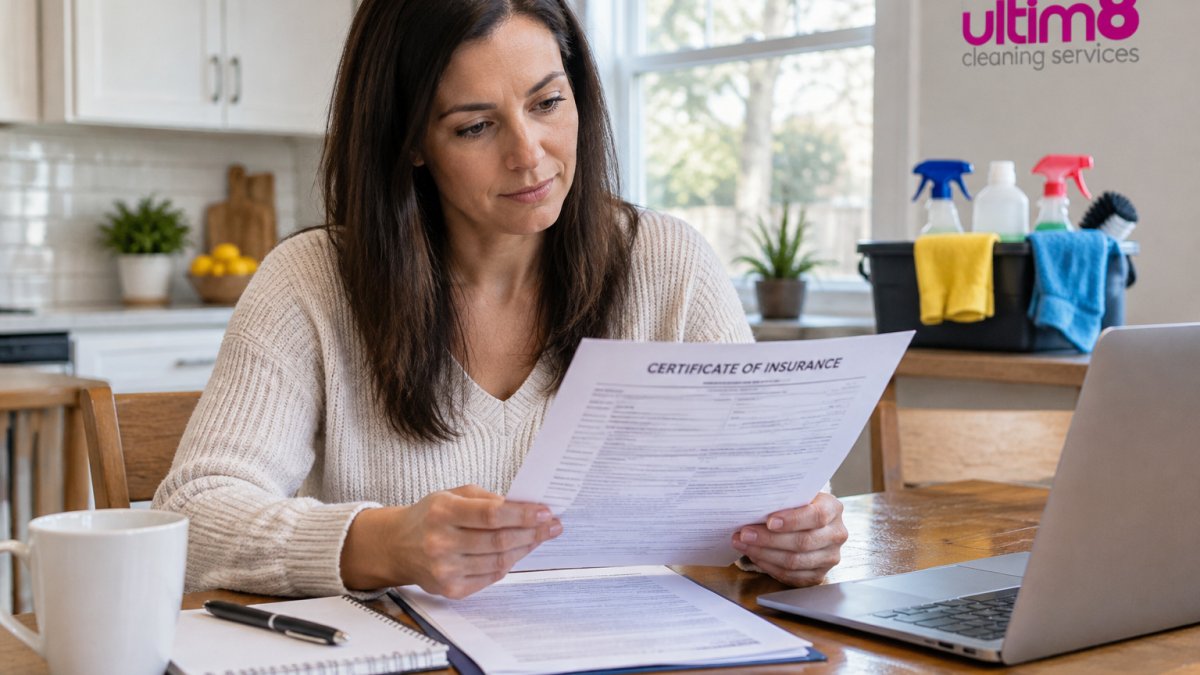
Ask for the COI before the first visit, naming you as certificate holder, the homeowner or renter for residential jobs, the property manager or business for commercial ones. To understand the protection it provides, read why hire insured cleaning services.
Read the COI for these fields:
- Insurer name and NAIC number. The NAIC number is a five-digit identifier assigned to each licensed insurer. Look it up in the NAIC’s public company search to confirm the insurer is real and licensed in your state.
- Producer (agent) name, address, and phone. This is the person or agency that issued the certificate. Use it only as a cross-check, not your sole contact source.
- Named insured. This must match the exact legal business name you verified with the Secretary of State. A trade name or DBA is acceptable only if linked to the legal entity in public records.
Authenticating the COI Independently
The single most important step is confirming the certificate with the insurer or agent using contact information you source yourself, not the phone number or email printed on the document.
- Find the insurer’s official contact details. Search the insurer’s name plus “policy verification” and use the phone number on the insurer’s own website. The NAIC company search also links to state insurance department records confirming the insurer is licensed.
- Call the insurer’s policy verification line. Ask whether a policy exists for the named insured, whether it is active today, and what lines and limits it carries. Insurers may confirm active or inactive status and coverage lines to a third party; policies vary in what they disclose.
- Ask the agent to confirm the certificate. Call the agency using a number you find independently, such as its website or a state insurance department licensee lookup. Ask the agency to confirm it issued the certificate and that the policies are in force.
- Request an updated certificate dated close to your start date. A certificate generated within the last 30 days is a reasonable freshness standard for a new engagement. For recurring service, ask for a new certificate at each renewal.
Watch out: a P.O. box as the agent address, a phone number that goes to voicemail with no business name, or an insurer name you cannot find in the NAIC search are all reasons to pause and verify further before letting anyone into the property.
Confirming the Policy Is Active and Covers Cleaning Work
A COI shows what was true when issued. To confirm current status, call the insurer and ask: Is the policy active today?
Coverage descriptions matter. A general liability policy for a cleaning company should list business operations that include cleaning services. If the description is vague, ask the agent to confirm the classification code.
Also ask whether the policy covers employees and subcontractors.
Verifying Bonds, Employee Coverage and Subcontractors
Bonds, employee coverage, and subcontractor coverage are where a cleaning company’s paperwork most often falls short. A valid general liability policy can still leave you exposed if the people doing the work are not covered.
Surety Bonds
A surety bond is a three-party agreement: the cleaning company (principal), the bonding company (surety), and the party protected (obligee). Because a bond addresses specific contractual obligations rather than every risk, verify the cleaner’s insurance and credentials as well, including when considering Arizona Junk Monkey Removal Services.
Ask for the bond number, bonding company’s name, and bond amount, then confirm directly with the bonding company using contact details you find independently. Ask whether the bond is active, what it covers, and who the obligee is.
Employee Coverage
Workers’ compensation responds when a cleaner is injured on your property. Many states require employers with employees to carry it, and thresholds vary; check your state’s rules.
On the COI, confirm workers’ compensation is listed with a policy number and a policy period covering your service dates. If the company says it has no workers’ compensation because all cleaners are independent contractors, ask each contractor for their own certificate of insurance.
Subcontractor Coverage
Ask who will actually be in your home or office. If the company uses subcontractors or temporary workers, its general liability policy may not cover them unless they are listed as insureds or the policy includes a blanket additional insured endorsement for subcontractors.
If subcontractors carry their own coverage, request a certificate for each and authenticate it the same way you did the company’s. If the company cannot confirm subcontractor coverage, treat that as a gap and ask for a different crew or provider.
Coverage Limits, Exclusions, and Additional Insured Status
A certificate shows limits, but limits only matter if the coverage responds. Review these points with the insurer or agent:
- General liability limits. Limits vary widely, so compare them to the value of the property being cleaned. Compare the limit to the value of the property being cleaned and the potential cost of a claim.
- Workers’ compensation limits. Confirm the workers’ compensation limits with the insurer. Confirm the policy is in force for your service dates.
- Exclusions. General liability policies commonly exclude damage to property in the insured’s care, custody, or control; damage from faulty workmanship; and injuries to the insured’s own employees. Ask the agent which exclusions apply to cleaning work and whether endorsements add back coverage.
When Coverage Is Missing or Insufficient
If a company cannot produce a current certificate, cannot confirm active coverage with the insurer, or cannot show the people doing the work are covered, do not let them start. Document what you requested and received, including dates and names. If you have already hired the company and a loss occurs, contact your own homeowner’s or renter’s insurance carrier and the company’s insurer, and keep photos, messages, and receipts.
What to Do If a Company Is Unlicensed or Uninsured
If a company cannot show a valid license where one is required, or cannot produce a current COI, do not hire them. Watch for these warning signs:
- Refusal to provide a certificate of insurance
- A COI that expired or names a different company
- Cash-only pricing with no written contract
If you already hired an unverified cleaner and something goes wrong, contact your own homeowner’s or renter’s insurance company. Document the damage with photos and keep any messages or receipts.
Questions to Ask Before Hiring a Cleaning Company
Bring these questions to your first call:
- What is your exact legal business name?
- Can you send a current certificate of insurance listing me as certificate holder?
- Are your cleaners employees or subcontractors, and are they covered?
A good company answers these without hesitation. Base your decision on the answers and the documents you verified.
Use these questions and the documents they should produce to compare cleaning companies before you hire.
| Question to ask | What a good answer includes | Red flag |
|---|---|---|
| What is your exact legal business name? | Name matches the Secretary of State record | Name differs from invoice or website |
| Can you send a current certificate of insurance? | COI naming you as certificate holder | Refusal to provide a certificate |
| Are your cleaners employees or subcontractors? | Clear answer with coverage confirmed | Vague or no answer |
| Do you carry a surety bond? | Bond number and bonding company named | No bond or no bond number |
| What is your process if something is damaged? | A stated damage process | Pressure to skip paperwork |
Booking Your Cleaning With Ultim8 Cleaning Services
Ultim8 Cleaning Services provides residential and office cleaning across the Tampa Bay area. Our cleaners are insured and background-checked, and we can provide a certificate of insurance before your first visit. For current pricing, request a quote through our website, since rates depend on the size of your space and the service you choose. Visit our website to request a quote or book your cleaning.
Frequently Asked Questions
How do I verify if a cleaning business is licensed?
Start with your state’s business registry, usually the Secretary of State’s website, and search the exact legal business name to confirm the company is registered and active. Then check whether your city or county requires a separate business license or occupational permit for cleaning work, since local requirements vary. Save screenshots or printed records with the date you checked, and note any license number shown so you can compare it with the number on the company’s paperwork.
Does a cleaning business need a license?
Requirements depend on the state, county and city where the business operates, so there is no single national rule. Many places require a general business license or registration, and some cleaning-related trades require specific permits. Because a license requirement can differ from one jurisdiction to the next, ask the company which licenses it holds and check them against your local government’s records rather than relying on a verbal assurance.
How do I verify a cleaning company’s insurance certificate?
Ask the company for a current certificate of insurance and confirm the insurer’s name, policy number, policy effective and expiration dates, and coverage limits. Then contact the insurance agent or carrier directly, using a phone number you find independently rather than one printed on the certificate, and ask them to confirm the policy is active. Check that general liability and workers’ compensation are both listed, and ask whether you are named as an additional insured if that matters for your property.
What should I do if a cleaning company cannot provide proof of insurance?
Treat a missing certificate as a serious warning sign and do not allow work to begin until you receive verifiable documentation. Without proof of coverage, damage to your property or injury to a worker could leave you responsible for costs. Consider hiring a company that can produce a current certificate, and keep a record of your request and the company’s response in case you need to resolve a dispute later.