
7 Steps to Prepare Your Home for Move-In Cleaners
November 6, 2026
Last Updated: November 5, 2026
Quick Summary
Green cleaning products for commercial offices are worth it when they carry third-party certification, disclose ingredients, and prove performance on your surfaces. Use EPA Safer Choice or Green Seal certification as your first filter, then trial two or three certified products on the surfaces your team touches daily.
- The global green cleaning products market reached USD 12.4 billion in 2025, projected to hit USD 24.8 billion by 2034.
- EPA Safer Choice reviews every ingredient before allowing the label; it is not a self-declared claim.
- Green Seal’s GS-37 standard covers general-purpose, restroom, glass, and carpet cleaners for offices.
- Verify certification per SKU, not per brand, because a green line can include uncertified products.
- Compare cost per diluted gallon rather than cost per bottle when weighing concentrates against ready-to-use products.
Table of Contents
- What Makes a Cleaning Product Green Enough for an Office
- EPA Safer Choice Cleaning Products: What the Label Actually Means
- Green Seal Certified Cleaning Products and Other Certifications to Check
- Green Cleaning Product Comparison for Commercial Offices
- How to Choose Commercial Cleaning Products for Your Workspace
- Your Office Cleaning Product Checklist
- Book a Green Cleaning Walkthrough for Your Office
- Frequently Asked Questions
What Makes a Cleaning Product Green Enough for an Office
The global green cleaning products market reached USD 12.4 billion in 2025 and is projected to hit USD 24.8 billion by 2034, an 8.0% annual growth rate (Dataintelo, 2025). That growth tells you something: offices are asking harder questions about what’s actually in the bottle.
Green cleaning products for commercial offices are cleaners formulated to reduce indoor air pollution and environmental harm while still meeting the cleaning demands of a shared workspace. The core concern is volatile organic compounds, or VOCs. According to the EPA’s guidance on identifying greener cleaning products, VOCs in cleaning products can affect indoor air quality and contribute to smog formation outdoors.
That matters in an office more than almost anywhere else. People sit in the same rooms for eight hours, breathing whatever the night crew sprayed twelve hours earlier.
So what separates a genuinely green product from a greenwashed one? Three things: third-party certification, ingredient transparency, and proven performance on commercial surfaces. Miss any one of those and you’re paying extra for a label.
EPA Safer Choice Cleaning Products: What the Label Actually Means
EPA Safer Choice cleaning products carry a label from a U.S. Environmental Protection Agency program that reviews every ingredient in a product for human health and environmental effects before allowing the mark. It is not a self-declared claim. A manufacturer has to submit its formula for review.
That distinction matters when you’re buying for an office. Plenty of products print “eco-friendly” or “natural” on the front with no outside verification behind it. The Safer Choice label means an agency chemist looked at the ingredient list.
Here’s what most buyers miss: the label covers the product’s chemistry, not its performance on your specific surfaces. A Safer Choice-certified glass cleaner still needs to work on your conference room table without leaving streaks. Certification gets you past the safety question, not the performance one.
Our advice? Use Safer Choice as your first filter, then test two or three certified products on the surfaces your team actually touches every day.
Green Seal Certified Cleaning Products and Other Certifications to Check
Green Seal certified cleaning products meet standards set by Green Seal, an independent nonprofit that writes environmental standards for institutional and industrial cleaning. GS-37, its standard for general-purpose, restroom, glass, and carpet cleaners, is the one most office buyers will encounter.
For an office manager comparing two certified products, the standard does the heavy lifting of ingredient review so you don’t have to read a safety data sheet line by line.
Beyond these two, you’ll see other marks. Look for certifications that require third-party testing and publish their criteria publicly. Be skeptical of in-house “green” seals a manufacturer created for its own products.
A quick way to vet any seal: search for the certifying body’s name plus “standard criteria.” If you can’t find published, specific criteria, the seal is decoration.
Green Cleaning Product Comparison for Commercial Offices
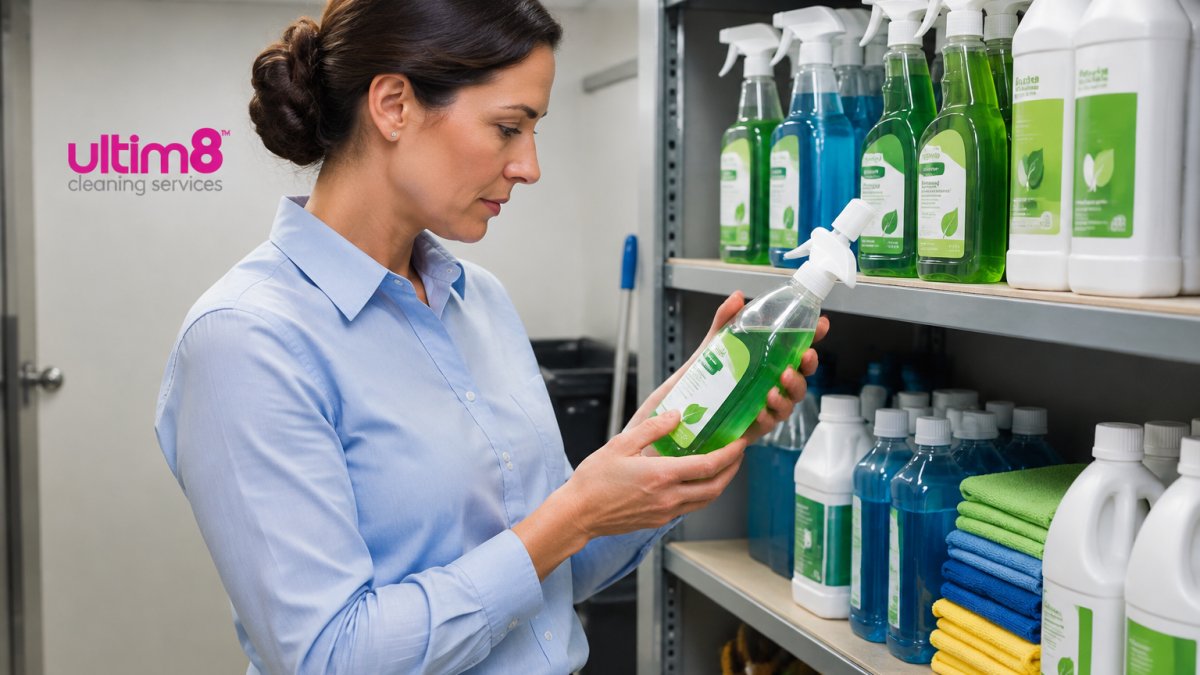
This section compares four commercial cleaning product lines and lists what a facilities buyer should verify before signing a supply contract. Ask suppliers for a quote against your square footage and cleaning frequency.
| Product Line | Typical Office Use | Certification to Verify | Dilution and Dwell Notes | What to Confirm in Writing |
|---|---|---|---|---|
| Simple Green Pro HD | Break room floors, loading docks, heavy grease | Check the current EPA Safer Choice listing for the specific SKU | Concentrated; dilution ratio is printed on the label and varies by task | Ratio chart, SDS, and whether the concentrate is approved for the surfaces you have |
| ECOS Pro | Full-range restroom, glass, and general cleaning | Certification varies by SKU; verify each product, not the line | Ready-to-use and concentrated options; dwell time differs between cleaners and disinfectants | Per-SKU certification letters and dilution instructions |
| Clorox EcoClean | High-touch disinfection where a registered disinfectant is required | EPA registration number on the label; Safer Choice where offered | Disinfectants need the full label dwell time to work; wiping early defeats the claim | EPA registration number, dwell time, and compatibility with your high-touch surfaces |
| Eco-Max | Buyers standardizing on one commercial eco line | Confirm current third-party certification per product | Concentrates require posted dilution ratios to avoid residue | Current certification documentation and dilution guidance |
Simple Green Pro HD is the pick when your break room floor or loading dock needs real degreasing power.
ECOS Pro suits offices that want one supplier across restroom, glass, and general cleaning.
Clorox EcoClean earns its place in offices with high-touch disinfection requirements. Cleaning and disinfecting are different jobs: a disinfectant only meets its label claim if the surface stays wet for the stated dwell time, which is often several minutes.
Eco-Max rounds out the comparison for buyers who want a commercial range rather than a single product. Request current documentation before committing, because certifications and formulations change between production runs.
On cost, compare cost per diluted gallon rather than cost per bottle. Ask each supplier for the dilution ratio, the pack size, and the recommended coverage per gallon. For a deeper cost-benefit breakdown, see whether eco-friendly office cleaning is worth the cost.
Watch out: a “green” line can include both certified and uncertified SKUs, so a line-level logo on a sell sheet proves nothing about the specific bottle that will arrive at your dock.
How to Choose Commercial Cleaning Products for Your Workspace
Start with your surfaces, not the product catalog. An office with granite reception desks, laminate workstations, and glass conference walls needs different products for each, and a certified all-purpose cleaner may not be right for all three. The selection process below is built for facilities teams that have to defend the choice to a building owner or a safety committee.
- Inventory your surfaces and finishes. Note which surfaces are sealed, porous, coated, or factory-finished. Check the surface manufacturer’s care guidance before you test anything, because some finishes are damaged by high-pH or solvent cleaners.
- Map high-touch zones separately from general cleaning. Door handles, shared keyboards, elevator buttons, and conference tables need a registered disinfectant applied at the label dwell time, not just a general cleaner wiped on and off.
- Verify certification per SKU, not per brand. Pull the certification listing for the exact product number you intend to buy, and keep the certificate on file with the safety data sheet.
- Get dilution and dwell-time documentation in writing. These two numbers drive both cost and results, and they are the first things an auditor or safety committee will ask for.
- Calculate cost per diluted gallon. Divide the pack price by the diluted volume the label specifies, then factor in the recommended coverage per gallon. This is the only apples-to-apples cost comparison between a concentrate and a ready-to-use product.
- Run a two-week trial on your real surfaces. Test on an inconspicuous area first, then expand. Record streaks, residue, and any finish dulling before you commit to bulk.
- Standardize and train. Post dilution ratios at the mixing station, keep safety data sheets accessible to staff, and confirm storage is locked and ventilated. Standardizing on fewer products reduces training burden and ordering errors.
Surface compatibility is where most programs fail quietly. A general-purpose cleaner that works on laminate can dull a waxed floor or leave haze on glass, and an abrasive bathroom product used on a coated conference table can scratch the finish permanently. Match the product to the finish, and keep glass and screen cleaners separate from abrasive restroom products.
Workplace health and safety belongs in the selection criteria, not after the fact. Review the safety data sheet for each product, note the ventilation requirements, and make sure the night crew knows which products require gloves or eye protection. In occupied offices, schedule stronger-smelling products for unoccupied hours and ventilate according to the label.
If you’re also vetting a cleaning provider, our guide on how to choose the right professional cleaning service covers what to ask before signing.
Watch out: buying a certified concentrate without posting the dilution ratio invites over-dosing, which wastes product, leaves residue, and can void the very performance claim you paid a premium for.
Your Office Cleaning Product Checklist
Use this list when auditing what’s already under your sink or ordering fresh stock:
- Every product has a third-party certification you can verify
- Disinfectants list an EPA registration number
- Safety data sheets are on file and accessible to staff
- Dilution ratios are posted where products are mixed
- High-touch surfaces have a dedicated disinfectant, not just a general cleaner
- Glass and screen cleaners are separate from abrasive bathroom products
- Storage is locked and ventilated
- Staff know which product goes on which surface
Before you duplicate supplies, check what a standard office cleaning service already includes. Many offices buy products their cleaning provider already brings.
Book a Green Cleaning Walkthrough for Your Office
Getting the products right is half the job. Applying them consistently, on the right surfaces, at the right frequency, is the other half, and it’s the half most offices struggle to staff.
Ultim8 Cleaning Services offers commercial office cleaning. Our insured and background-checked cleaners use high-quality, environmentally safe products, work through detailed checklists, and offer instant online booking. You can see the full scope in our commercial office cleaning benefits overview or check office cleaning service details for your area.
Frequently Asked Questions
Are green cleaning products as effective as conventional cleaners?
For routine office cleaning, yes. Green Seal’s GS-37 standard covers general-purpose, restroom, glass, and carpet cleaners for institutional use, which means certified products have been tested against performance criteria for those jobs. The gap narrows further when products are used correctly: proper dwell time and dilution matter more than the formula. Heavy-duty or disinfecting tasks may still call for a specialized product, so match the cleaner to the surface and soil rather than assuming one bottle handles everything.
What certifications should commercial offices look for in green cleaners?
Two carry the most weight for office buying. EPA Safer Choice reviews ingredient safety, and Green Seal certifies products against standards like GS-37 for industrial and institutional cleaners. Both are third-party programs, so the claim is verified rather than self-declared. Ask suppliers for the certification and the product category it covers, since a certified general-purpose cleaner and a certified glass cleaner are separate listings. Ingredient disclosure on the label or safety data sheet fills in the rest.
Are green cleaning products more expensive for businesses?
The upfront bottle price is often higher, but that is not the full picture. Concentrates reduce cost per use, and certified products typically carry lower VOC levels, which the EPA links to indoor air quality concerns. Total cost of ownership includes dilution ratios, how many products you need to cover all surfaces, and staff training time. Request pricing directly from suppliers, since per-case costs vary widely by volume and contract terms, and compare cost per diluted gallon rather than sticker price.
How should staff use and store commercial cleaning products safely?
Follow the label dilution ratio exactly, keep secondary spray bottles labeled, and store concentrates away from food areas and out of reach of unauthorized staff. The EPA notes that VOCs in cleaning products can affect indoor air quality, so ventilate during use and avoid mixing products. Train staff on the safety data sheet for each item and post a simple chart showing which cleaner goes on which surface. A written checklist reduces guesswork and keeps results consistent between cleaning crews.
The challenge is simple: most offices buy green products without a system for using them correctly. We built ours around certified products, trained staff, and checklists that don’t skip the high-touch surfaces. Get started with Ultim8 Cleaning Services and give your team a healthier workspace without adding a single task to anyone’s list.