
Deep Cleaning vs Move-Out Cleaning: What to Expect
November 4, 2026
How to Choose the Right Professional Cleaning Service
November 5, 2026
Last Updated: November 4, 2026
Quick Summary
When hiring house cleaners, first confirm the company is bonded, licensed and insured, and ask for proof. Then check background screening and references, put the service agreement in writing, and book a trial clean before committing.
- Ask for a current certificate of insurance and confirm the coverage is active.
- Bonding protects you against theft by an employee, while insurance covers damage or injury.
- Call two or three recent references and ask about punctuality and communication.
- Walk away from a company that refuses to put the service agreement in writing.
- Book one standard trial clean before signing up for a recurring plan.
Table of Contents
- Why Vetting a House Cleaner Matters Before the First Visit
- How to Verify Cleaning Service Insurance and Bonding
- Background Checks, References and Reviews
- Questions to Ask House Cleaner Before Hiring Them
- House Cleaning Service Red Flags to Watch For
- Average Cost of House Cleaning Services and How Quotes Are Built
- Booking a Trial Clean and Setting Up Access, Supplies and Communication
- Frequently Asked Questions
Why Vetting a House Cleaner Matters Before the First Visit
Hiring a house cleaner means letting someone into your home, often when you are not there. That is why the hiring house cleaners process deserves more care than most people give it.
Most people go by a recommendation or a low price and hope for the best. A short vetting step protects your home, your belongings and your peace of mind. It also helps you avoid the frustration of a cleaner who does not match what you expected.
The industry is more formal than many homeowners realize. The same checks matter when hiring insured exterior cleaners, since confirming coverage and responsibility helps clarify who bears the risk if work goes wrong.
Here is what the rest of this guide covers:
- Confirming insurance and bonding
- Running background checks and reading reviews
- Asking the right questions before you hire
- Spotting red flags early
- Understanding what a fair price looks like
- Setting up a trial clean and clear expectations
How to Verify Cleaning Service Insurance and Bonding
Before anything else, ask whether the company is bonded, licensed and insured. Industry guidance stresses that these checks are not optional when you vet a professional service (Merry Maids guidance on bonded, licensed and insured status). For more on why insured cleaning services matter, read why hire insured cleaning services.
Here is what each term means:
- Insurance protects you if a cleaner damages your property or gets hurt on the job.
- Bonding protects you against theft by an employee.
- Licensing shows the business meets local rules for operating.
Ask for a current certificate of insurance and check that the coverage is active. Do not rely on a verbal promise. Professional organizations also recommend putting the scope of work in writing so there is no confusion about what is included (Domestic Employers guidance on written service agreements).
Watch out: a company that cannot produce proof of insurance should not be let into your home.
Background Checks, References and Reviews
Background checks are the second layer of protection. You can read more about how we vet our own team on our how to find the perfect house cleaner in Sarasota page.
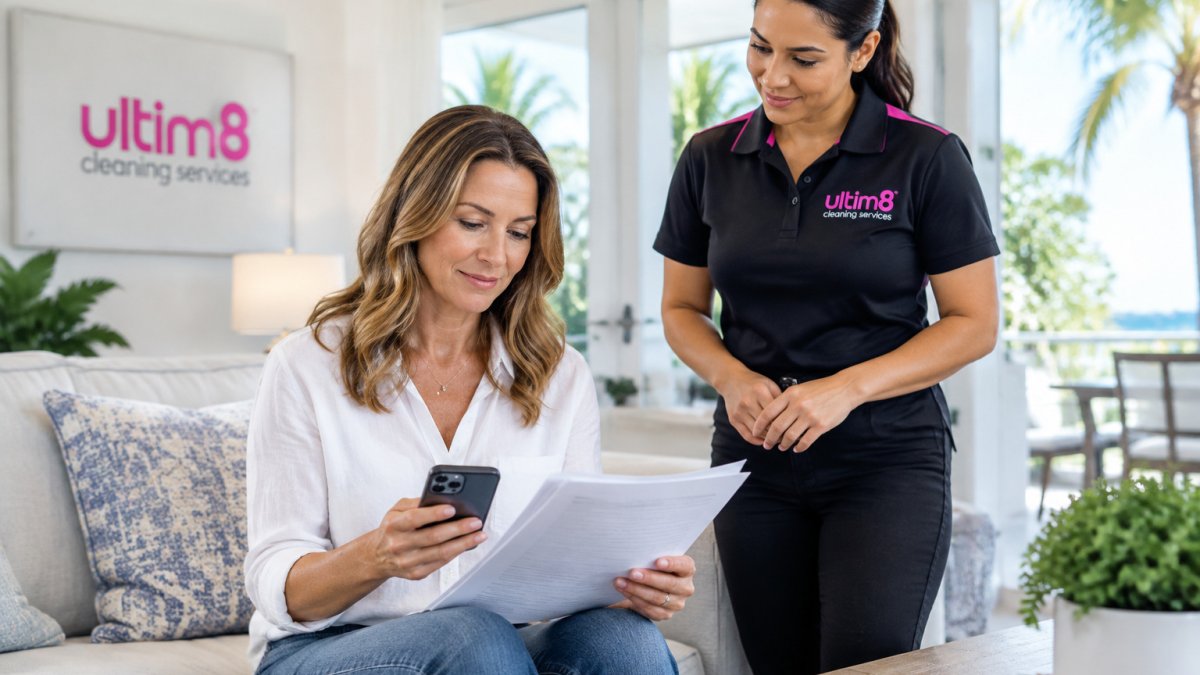
References and reviews give you a real picture of reliability. Ask for two or three recent references and call them.
Check online reviews as well. A pattern of repeated comments about missed spots, late arrivals or damage is a clear signal. A single complaint is less important than how the company responded to it.
Consistency is what many busy households are really looking for. One customer put it this way: “She does such a great job and is very consistent.”
Questions to Ask House Cleaner Before Hiring Them
The right questions reveal how a company works. Ask these before you book:
- Are you bonded, licensed and insured? Can you send proof?
- Are your cleaners employees or independent contractors?
- Who provides the cleaning supplies and equipment?
- Do you use eco-friendly products, and which ones?
- What does your satisfaction guarantee cover?
- How do you handle keys, alarm codes and entry instructions?
- Will the same cleaner come each time?
Pay close attention to the answers about key management and access. Digital security matters as much as physical cleaning. A good company will explain how keys and codes are stored, who can access them and how they are removed after a job.
For a fuller walkthrough of vetting steps, read our guide on how to vet professional house cleaners before you hire.
House Cleaning Service Red Flags to Watch For
Some warning signs show up early. Walk away if you notice any of these:
- No proof of insurance or bonding
- Refusal to put the service agreement in writing
- Vague answers about who does the work
- Pressure to pay everything up front
- Prices far below the local market
That last point deserves extra attention. Suspiciously low pricing often signals a lack of professional standards, insurance or quality guarantees (Business Insider on low-priced service red flags).
Average Cost of House Cleaning Services and How Quotes Are Built
Cleaning prices vary with home size, condition, the type of clean and how often you book. We do not publish fixed prices because the right number depends on your specific home.
That said, you should understand how quotes are built so you can compare them fairly. Most residential cleaning companies in the United States price using one of three models:
- Flat-rate (per visit): A fixed price based on square footage, number of bedrooms and bathrooms, and the type of clean. This is the most common model for recurring service because it makes budgeting predictable.
- Hourly: Charged per cleaner-hour, often with a two- or three-hour minimum. Hourly pricing is more common for one-time, deep or move-out cleans where the scope is harder to predict.
- Per-room or per-task: A base rate plus add-ons for specific rooms or tasks (inside oven, inside fridge, interior windows, baseboards). This model is transparent but can add up quickly if you select many extras.
Most quotes are built from a few factors:
- Square footage and number of rooms
- Whether it is a standard, deep or move-out clean
- How often the cleaning recurs
- Any add-ons, such as inside the fridge or windows
- Whether supplies and equipment are included
Typical frequency is once a week or every two weeks, which many households find the best balance (Domestic Employers on standard cleaning intervals). Recurring clients usually pay less per visit than one-time clients because the home stays consistently maintained and the cleaner spends less time on buildup.
When you compare quotes, make sure each one covers the same scope. You can see how an instant quote works on our instant quote for house cleaning page, and compare what a full pricing guide includes in our residential cleaning services cost guide.
Tipping is a separate question. Many clients tip around 20% for good service, which is a common community standard (Reddit r/housekeeping community guidance on tipping).
Watch out: a quote that is dramatically below the local market can signal missing insurance, no background screening or a bait-and-switch where later visits cost more. Ask what the price will be on visit two, not just visit one.
The article breaks down the three common pricing models and the factors that shape a quote.
| Pricing model | How it is charged | Best suited for |
|---|---|---|
| Flat-rate (per visit) | Fixed price based on size and clean type | Recurring service and predictable budgeting |
| Hourly | Per cleaner-hour, often with a 2-3 hour minimum | One-time, deep or move-out cleans |
| Per-room or per-task | Base rate plus add-ons for specific tasks | Transparent pricing with selected extras |
Booking a Trial Clean and Setting Up Access, Supplies and Communication
A trial clean is the best low-risk test. Book one standard clean before you commit to a recurring plan. Use it to check thoroughness, punctuality and communication.
Before the first visit, agree on these details:
- Access: how the cleaner gets in and how keys are returned
- Supplies: what the company brings and what you provide
- Checklist: the rooms and tasks covered
- Communication: the best way to reach the team with questions or feedback
- Scheduling: what happens if you need to reschedule
What the service agreement should actually contain
Most competitors stop at “get it in writing.” A standard residential cleaning agreement should spell out the following, and you should read each clause before you sign:
- Scope of work: the exact rooms, surfaces and tasks included, plus a list of add-ons that cost extra.
- Frequency and schedule: weekly, biweekly or monthly, with the day and time window.
- Cancellation and rescheduling policy: how much notice is required and whether a late-cancellation fee applies. A common pattern is a fee if you cancel within 24 to 48 hours.
- Liability and damage: what the company covers if something is broken or damaged, and whether you must report it within a set window (often 24 to 48 hours).
- Insurance and bonding confirmation: the agreement should reference the company’s coverage, not just promise it verbally.
- Payment terms: when payment is due, accepted methods, and whether tips are expected or included.
- Termination: how either side ends the arrangement and what notice is required.
- Access and key policy: how keys, codes and entry instructions are handled and returned.
If a company will not put these terms in writing, treat that as a red flag.
Digital security and key management
Smart locks, alarm codes and digital privacy are worth considering when giving anyone access to a home. Ask sharper questions such as:
- Smart locks: If you use a smart lock, ask whether the company can accept a temporary access code rather than a permanent one. A temporary code that expires after the visit is safer than sharing your master code.
- Alarm codes: Provide a separate, temporary alarm code if your system supports it, and change it after the engagement ends. Do not share the master user code.
- Key storage: If you leave a physical key, ask how the company stores it, a locked office, a key safe, or a tracked key log, and who has access.
- Digital privacy: Ask whether cleaners are permitted to use phones or cameras in your home, and whether the company has a policy on photos taken for quality control.
- Access removal: Confirm in writing how keys, codes and app access are removed when the service ends or the cleaner leaves the company.
Watch out: a company that cannot explain its key and code policy in specific terms is a security risk you do not need to take.
Communication and feedback
Clear communication prevents most problems. Agree on a primary channel (text, email or app) and a response-time expectation. If something is missed, give specific feedback rather than a vague complaint, point to the room and the task. Feedback given promptly lets the company fix issues on the next visit.
If you run a home office or have high-touch areas, tell the team up front. Our cleaners are trained to work through detailed checklists, and clear instructions help get the details right.
Ready to get started? Book now with Ultim8 Cleaning Services for insured, background-checked cleaners who work through a detailed checklist on every visit.
Frequently Asked Questions
What should I ask a house cleaner before hiring them?
Ask whether the company is bonded, licensed and insured, and request a certificate of insurance sent directly from the insurer. Confirm whether cleaners are W-2 employees or independent contractors, since that determines who is liable if something is damaged. Ask what products they use, whether they bring their own supplies, how they handle keys or alarm codes, and what happens if you are not satisfied. Good companies answer these questions clearly and can explain the scope of work.
How do I know if a house cleaning service is trustworthy?
Check for a verifiable business address, a clear written service agreement, proof of general liability insurance and workers’ compensation coverage, and a documented background screening process for every cleaner who enters your home. Read recent Google reviews rather than only the top-rated ones, and look for consistent comments about reliability and communication. A trustworthy company gives you a named point of contact and a clear process for handling complaints.
How do I verify cleaning service insurance and bonding?
Ask the company for a current certificate of insurance and contact the insurer listed on it to confirm the policy is active and covers the dates you need. Bonding is different from insurance: a bond protects you against theft by employees, so request proof of a fidelity bond if you plan to give cleaners keys or alarm access. Confirm that the business is properly registered and holds any local business license or tax receipt required where it operates.
What are the red flags when hiring a house cleaner?
Be cautious of prices far below the local market, refusal to sign a written agreement, no proof of insurance, cash-only payment, pressure to prepay in full, and vague answers about who will be in your home. Another warning sign is a company that will not explain its background check process or that sends a different cleaner every visit without notice. Any of these issues justifies choosing a different provider.