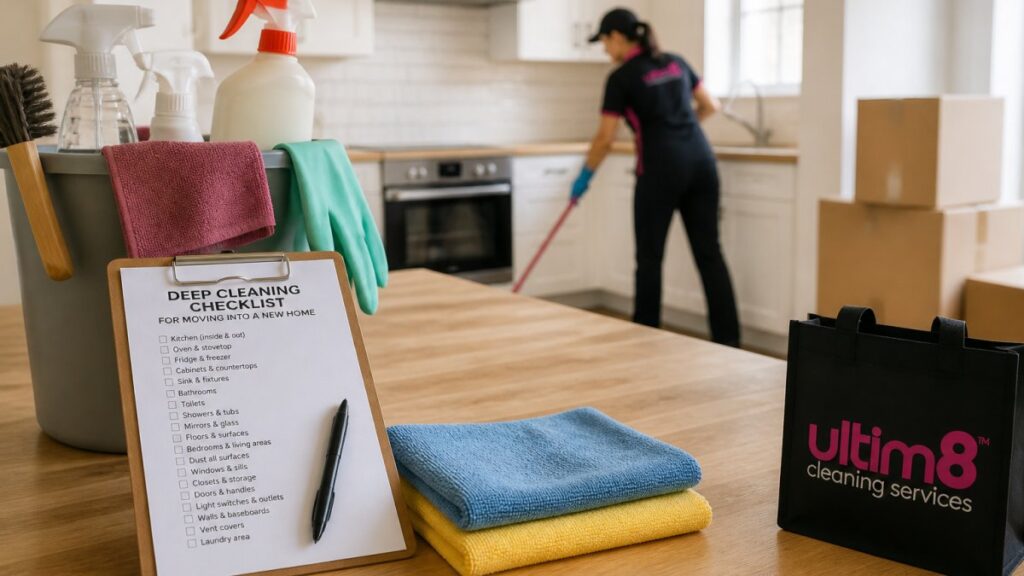
Deep Cleaning Checklist for Moving Into a New Home
October 14, 2026
Table of Contents
- Why Vetting Residential Cleaning Staff Matters
- Step 1: Verify Business License and Registration
- Step 2: Confirm Cleaning Service Insurance and Bonding
- Step 3: Request and Review House Cleaner Background Check Results
- Step 4: Ask the Right Questions to Ask a House Cleaning Service
- Step 5: Evaluate House Cleaning Service References
- Step 6: Assess Professionalism and Communication
- Step 7: Start with a Trial Cleaning and Written Agreement
- Frequently Asked Questions
Last Updated: October 14, 2026
Why Vetting Residential Cleaning Staff Matters
Inviting someone into your home means granting access to your personal space, belongings, and family’s daily life. That’s why you need to vet residential cleaning staff carefully, it’s essential.
Vetting a cleaner properly protects your home, family, and peace of mind.
This guide covers seven concrete steps to vet residential cleaning staff thoroughly, what to ask, what documents to request, and how to spot red flags before hiring.
Step 1: Verify Business License and Registration
Confirm the cleaner operates as a legitimate business, your first defense against unlicensed operators.
Ask for proof of business registration showing the business name, registration number, and date.
A sole proprietor operating under their own name is acceptable, but they should still show proof of registration.
A business license shows accountability and separates professional services from informal cash-only arrangements.
Step 2: Confirm Cleaning Service Insurance and Bonding
Insurance and bonding protect you if something goes wrong, non-negotiable.
Ask for proof of liability insurance. This covers damage to your home or belongings. Request a certificate showing coverage amount and policy dates.
Verify bonding separately. A bond protects you financially if the cleaner steals or fails to complete work. Ask for a current bond certificate.
Don’t accept verbal assurances.
Don’t skip this step.
Step 3: Request and Review House Cleaner Background Check Results
A background check is only as good as the process behind it. Any service can claim “we run background checks”, your job is to separate a verifiable screening process from a marketing claim. This step matters most when you’re handing over a key.
What a real screening process includes
A thorough residential cleaning background check layers several searches rather than relying on one database:
- Identity verification, confirming the name, date of birth, and address history match the person, so records aren’t attributed to the wrong individual.
- County criminal record search, the courthouse-level search where most cases actually live. A national database alone often misses these.
- Statewide criminal record search, captures cases filed outside the applicant’s current county.
- Federal criminal record search, covers federal offenses, which county and state searches won’t surface.
A single instant database lookup is not a courthouse-verified search, databases can be stale, incomplete, or matched to the wrong person. Ask which searches were actually run.
The legal framework you should know
When a third-party company performs the screening, the Fair Credit Reporting Act (FCRA) governs how it’s done, rules that make a check trustworthy: (the FTC)
- The employer must get the applicant’s written consent before the check (the FTC).
- The screening company must follow disclosure and authorization requirements.
- If adverse action is taken based on the report, the applicant has rights to a copy and a chance to dispute errors.
A service that runs checks “off the books” without consent isn’t more thorough, it’s a liability. A compliant process protects the applicant and gives you a reliable report.
Some states and localities restrict how far back criminal history can be considered, and “ban-the-box” rules may limit when an employer can ask about records (Arrest and Conviction Records: Resources for Job Seekers, Workers and Employers). A legitimate service will know the rules that apply where it operates. If a company brags about ignoring those limits, treat it as a red flag about how they handle everything else.
Documents and answers to request
Ask these questions and expect specific answers:
- “Which screening company do you use, and are they FCRA-compliant?”
- “Which searches are included, county, state, federal, and sex offender registry?”
- “When was the most recent check completed for the person coming to my home?”
- “Do you re-screen on a set schedule, or only at hire?”
You won’t receive the full report, it contains private personal data. Expect written confirmation that a compliant check was completed, the date, and the scope of searches.
What a background check does and does not tell you
A check confirms whether certain records exist, not whether someone is reliable, careful, or honest on the job. It also won’t catch offenses never charged or outside the search window.
A criminal record doesn’t automatically disqualify someone, and its absence doesn’t guarantee a good hire. Use the check as one input, paired with references, a trial clean, and the interview questions ahead.
A verifiable screening process has three markers: written consent, an FCRA-compliant screening company, and layered county, state, federal, and registry searches. If a service can’t name the company or the searches, you’re hearing a claim, not a check.

Step 4: Ask the Right Questions to Ask a House Cleaning Service
Direct conversation reveals a cleaner’s professionalism, experience, and reliability. Ask the right questions and listen carefully.
Experience and Training Questions
Ask: “How long have you been cleaning homes?”
Ask about training.
Ask about specializations: “Have you cleaned homes similar to mine?”
Services and Expectations Questions
Clarify what’s included: “What does your standard cleaning include?” Get a detailed list, baseboards, ceiling fans, inside cabinets, windows, bathrooms, kitchens.
Ask about frequency: “Can you accommodate weekly, bi-weekly, or monthly cleaning?”
Ask about problem areas: “How do you handle tough stains or buildup?” This reveals problem-solving skills and tools.
Ask about products: “What cleaning products do you use?” With pets, children, or chemical sensitivities, you need to know what’s sprayed in your home, including whether they offer eco-friendly options.
Pricing and Terms Questions
Ask for a written estimate before committing. Never accept vague pricing, know exactly what you’re paying and getting.
Ask about payment terms: upfront, on completion, or monthly? Any cancellation penalties?
Ask about guarantees: “What’s your satisfaction guarantee?”
Step 5: Evaluate House Cleaning Service References
References from past clients reveal how the cleaner actually performs. Don’t skip this step.
Ask for at least three references from clients of six months or more, long-term clients have seen the cleaner’s consistency over time.
When you call references, ask specific questions:
- “Were they reliable and on time?”
- “Did the cleaning meet your expectations?”
- “Did they handle your home and belongings carefully?”
- “Would you hire them again?”
Watch for hesitation or vague answers. Enthusiastic, detailed responses are a good sign; reluctance is meaningful.
Also check Google, Yelp, and the Better Business Bureau for patterns.
Step 6: Assess Professionalism and Communication
How a cleaner communicates before hiring predicts how they’ll work for you.
Check responsiveness: do they answer promptly and follow through? A cleaner slow to respond before hire is likely the same after.
Assess clarity: can they explain services, pricing, and policies, and do they ask questions to understand your needs?
Watch for red flags in communication:
- Unwillingness to put agreements in writing
- Vague or evasive answers to your questions
- Pressure to decide quickly without time to think
- Requests for large upfront payments
Professional cleaners welcome questions, understand the decision matters, and are transparent and patient.
Step 7: Start with a Trial Cleaning and Written Agreement
A trial clean is your only chance to see the work before committing. To make it meaningful, score it against specific criteria so you compare evidence, not impressions.
Set up the trial to be a real test
Book a single appointment or short trial rather than a long-term contract. Before the visit:
- Write a room-by-room checklist of what you expect cleaned. Be specific, baseboards wiped, inside microwave, under furniture edges, bathroom grout, ceiling fan blades.
- Note your priorities. If the kitchen and bathrooms matter most, say so and weight them accordingly.
- Decide your access method in advance. Will you be home, or will you grant entry another way? (See the access and security guidance below.)
- Photograph any pre-existing damage to surfaces or valuables so there’s no dispute later.
Score the clean room by room
Walk the home after the visit and rate each area. A simple 1-5 scale per item keeps it objective:
Kitchen
- Counters and backsplash free of residue and streaks
- Sink and fixtures polished, drain area clean
- Appliance exteriors wiped; inside microwave and oven if agreed
- Floor edges and corners reached, not just the open center
Bathrooms
- Toilet base, hinges, and behind the bowl cleaned
- Grout and tile scrubbed, not just sprayed
- Mirror and glass streak-free
- Fixtures and handles disinfected
Living and bedrooms
- Surfaces dusted including under and behind items
- Floors vacuumed to edges; hard floors mopped without streaks
- Beds made or linens changed if in scope
- No damage to furniture, electronics, or decor
Throughout
- Trash removed and bins relined
- Nothing moved and left out of place
- No chemical odors lingering or surfaces left wet
Evaluate the non-cleaning factors too
Quality is only part of the test. Also score:
- Punctuality, did they arrive in the agreed window?
- Communication, did they flag anything unexpected or ask before acting?
- Care, were belongings handled carefully and returned to place?
- Time, did the job take a reasonable amount of time for the scope?
Turn the trial into a decision
After scoring, you have three outcomes:
- Hire. Most items score well and misses are minor. Move to a written agreement.
- Re-clean or clarify. Raise specific misses, how they respond tells you as much as the clean itself.
- Pass. Repeated misses, damage, lateness, or evasiveness mean keep looking.
Keep your scored checklist. If you hire, it becomes the baseline for every future visit, and the reference point if quality ever slips.
Lock it in with a written agreement
If the trial goes well, put the arrangement in writing. A solid agreement covers:
- Scope of work, exactly what gets cleaned, referencing your checklist
- Frequency and schedule, weekly, bi-weekly, or monthly, with arrival windows
- Pricing and payment terms, amount, method, and due date
- Cancellation and rescheduling policy, notice required and any fees
- Satisfaction and re-clean policy, what happens if you’re not happy
A written agreement protects both sides, removes ambiguity, and gives you a clear path if something goes wrong.
Protect your home access and privacy
Granting entry carries the most risk. A few safeguards:
- Use a unique code, not your master one. Create a temporary smart-lock or alarm code for the cleaner and delete it when the arrangement ends.
- Limit what you share. They need entry and a checklist, not your Wi-Fi password, safe combination, or away schedule.
- Keep valuables out of the cleaning zone. Lock up jewelry, cash, and documents before each visit.
- Track access. A smart lock shows entry and exit times, doubling as a reliability record.
- Change codes when you part ways. Revoke access the same day, regardless of how it ends.
The trial clean is only as useful as the criteria you score it against. Build a room-by-room checklist, rate quality and reliability, and let the scores, not the first impression, drive your decision. Then put the terms in writing and control access with a code you can revoke.
Frequently Asked Questions
What should I check before hiring a house cleaner?
Before hiring, verify business registration and licensing, confirm liability insurance and bonding, review background check results, check references from previous customers, and ask about experience and training. Request a written estimate that outlines the scope of work, pricing, and payment terms. A trial cleaning helps you assess quality and professionalism before committing to ongoing service.
Should residential cleaners be background-checked?
Yes. Background checks are essential when allowing someone access to your home. Ask the cleaning service whether they conduct FCRA-compliant background screening of all staff, including checks for criminal records. Request proof of screening results or documentation from a third-party screening provider. This protects your home, family, and belongings.
How can I verify a cleaning company’s insurance and bonding?
Request a certificate of liability insurance directly from the cleaning service and verify it with their insurance provider. Ask whether staff are bonded, which protects you if items are damaged or lost. A reputable service will provide proof without hesitation and explain their coverage limits clearly.
What makes a good house cleaning service reference?
Strong references come from customers who have used the service for several months or longer and can speak to consistency and reliability. Ask references specific questions: Did the cleaners show up on schedule? Did they respect your home and privacy? Was the quality thorough? Do you feel safe with them in your home? Online reviews on Google and other platforms also provide valuable feedback from multiple customers.