Hourly vs Flat Rate House Cleaning: Pros and Cons
September 29, 2026
Table of Contents
- Office Cleaning vs Residential Cleaning Services: Quick Comparison
- Scope of Work: What Each Service Covers
- Equipment, Chemicals, and Safety Standards
- Commercial Cleaning Checklist and Standards
- Residential Cleaning Service Rates and Pricing Models
- Benefits of Professional Office Cleaning
- Training, Certification, and Security Protocols
- Scheduling Frequency and Customization
- Frequently Asked Questions
Last Updated: September 29, 2026
Office Cleaning vs Residential Cleaning Services: Quick Comparison
Office cleaning vs residential cleaning represents fundamentally different service models with distinct requirements, equipment, and operational standards.
Ultim8 Cleaning Services provides both residential and office cleaning solutions across the Tampa Bay area. The scope, frequency, and approach differ significantly between these service types.
Office cleaning prioritizes high-touch surfaces, multiple zones, and contractual service level agreements. Residential cleaning focuses on thorough deep cleaning and personalized attention in a single-family environment.
Scope of Work: What Each Service Covers
Commercial office cleaning scope
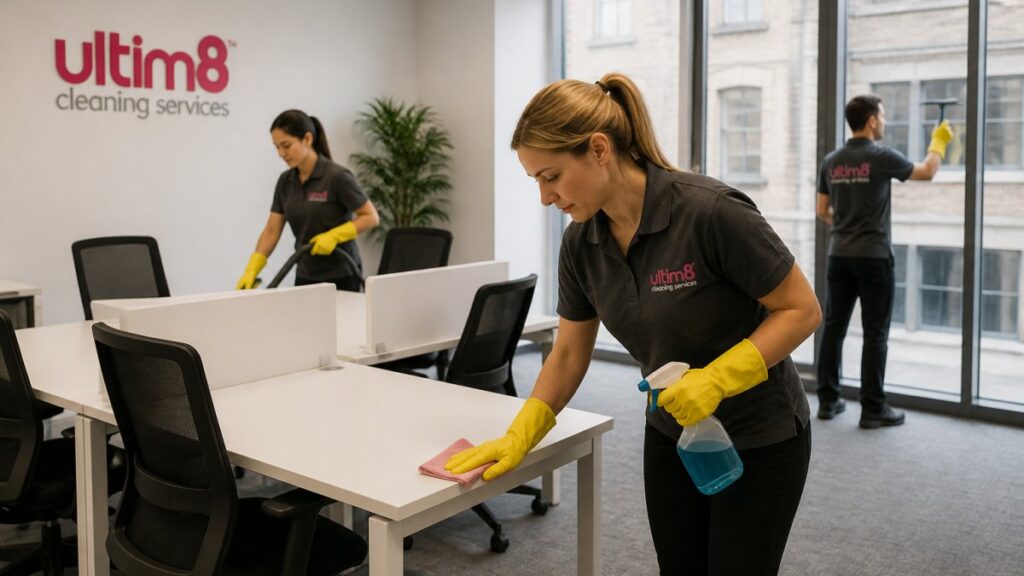
Commercial office cleaning handles specialized tasks that maintain workplace hygiene, employee productivity, and regulatory compliance across multiple zones and high-traffic areas.
Commercial cleaning includes restroom sanitization, floor care, desk cleaning, high-touch surface decontamination (door handles, light switches, elevator buttons), trash removal, window washing, and break room sanitization. Many contracts also require carpet extraction, upholstery cleaning, and detailed checklists for consistency.
Commercial office cleaning scope is defined by service level agreements specifying which areas are cleaned, how often, and to what standard, essential because disruptions affect employee productivity and client perception.
Residential cleaning service scope
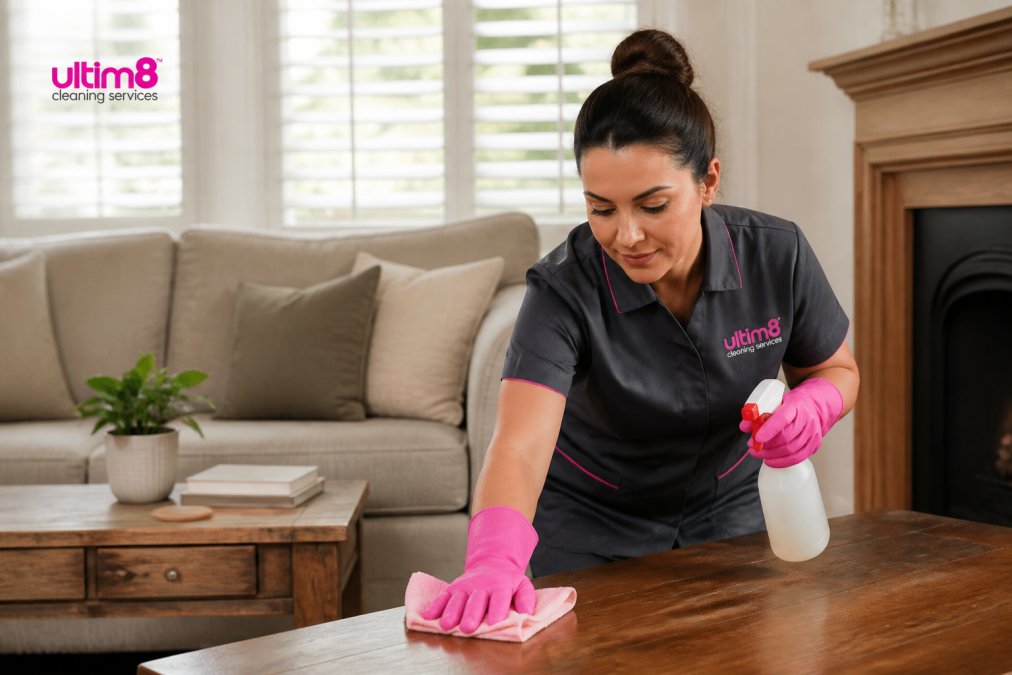
Residential cleaning focuses on thorough, detailed attention to a single living space, prioritizing bedrooms, bathrooms, kitchens, and living areas.
Residential cleaning includes bathroom and kitchen cleaning, dusting, floor care, trash removal, and optional laundry or bed-changing services. Many clients request specialized deep cleaning for move-in/move-out, seasonal needs, or post-event cleaning.
Residential cleaning emphasizes personalized attention and flexibility rather than contractual specifications. Teams adapt to client preferences without rigid scheduling requirements.
Residential clients often appreciate when cleaning teams work independently without constant supervision. Ultim8 Cleaning Services trains staff to follow detailed checklists so you can work from home or run errands without managing the process.
Equipment, Chemicals, and Safety Standards
Office cleaning and residential cleaning operate under fundamentally different regulatory and safety frameworks.

Commercial office cleaning: Regulatory compliance and industrial standards
Commercial office cleaning must comply with OSHA’s Hazard Communication Standard (29 CFR 1910.1200), requiring Safety Data Sheets (SDS) and documented staff training on chemical handling, dilution, storage, and emergency procedures.
Commercial cleaners must follow EPA guidelines for disinfectants, using only EPA-registered products with verified contact times and efficacy standards to ensure measurable pathogen reduction (the EPA).
Commercial-grade vacuums must meet HEPA filtration standards, capturing 99.97% of particles 0.3 microns or larger. Floor buffers, carpet extraction machines, and pressure washers must be maintained to manufacturer specifications and operated by trained staff.
Industrial-strength chemical products contain quaternary ammonium compounds, hydrogen peroxide, or hypochlorous acid, requiring specific contact times (30 seconds to 10 minutes) for efficacy. Improper dilution renders products ineffective, so commercial contracts require staff certification and audits.
Residential cleaning: Flexibility and consumer-grade standards
Residential cleaning operates under fewer regulatory constraints, allowing use of eco-friendly, plant-based cleaners and essential oil-based disinfectants that appeal to health-conscious homeowners.
Residential equipment is lighter-duty and more affordable, using standard vacuums and microfiber tools effective for household soiling but not designed for high-volume commercial demands.
Residential cleaning does benefit from transparency around chemical safety, even without regulatory mandate. Many homeowners specifically request non-toxic, hypoallergenic products to protect children, pets, and family members with sensitivities. Ultim8 Cleaning Services uses high-quality, environmentally safe products across both residential and office services, ensuring that your space is sanitized without harsh chemical residue or respiratory irritants.
Key compliance differences
| Compliance Factor | Commercial Office Cleaning | Residential Cleaning |
|---|---|---|
| OSHA Hazard Communication Standard | Required; SDS documentation and staff training mandatory | Not required |
| EPA Disinfectant Registration | Must use EPA-registered products with verified kill times | Not required; consumer-grade products acceptable |
| HEPA Filtration Equipment | Standard requirement for vacuums and air handling | Optional; standard equipment sufficient |
| Staff Certification | Often required; chemical handling and safety training documented | Not required; professional training recommended |
| Audit and Documentation | Routine; cleaning logs, chemical inventories, staff certifications | Not required; feedback-based quality assurance |
| Chemical Dilution Standards | Precise ratios required per SDS; improper dilution voids efficacy claims | Flexible; homeowner preference drives choices |
For office managers, this regulatory framework means that hiring a professional commercial cleaning company transfers compliance responsibility to the provider. A reputable commercial cleaner maintains SDS documentation, trains staff on chemical safety, uses only EPA-registered disinfectants, and can provide audit trails proving that your facility meets occupational health standards. For residential clients, the flexibility to choose eco-friendly or specialty products reflects personal values without sacrificing cleanliness or safety.
Commercial Cleaning Checklist and Standards
A commercial cleaning checklist ensures consistency and accountability across every visit, essential in office environments where multiple clients, employees, and visitors expect the same standard.
A typical commercial cleaning checklist includes restroom disinfection, trash removal, floor care, high-touch surface decontamination, window cleaning, break room sanitization, and spot cleaning. Many contracts require documentation with timestamps and photos for audit trails.
The checklist-based approach removes ambiguity, prevents missed areas, and creates accountability with documented proof of service delivery.
Residential cleaning, by contrast, relies less on rigid checklists and more on responsive cleaning based on the home’s specific needs and the client’s feedback. While Ultim8 Cleaning Services trains all staff to work through detailed checklists, residential clients appreciate the flexibility to request adjustments, skip certain areas, or ask for extra attention in specific rooms without derailing the entire service model.
Residential Cleaning Service Rates and Pricing Models
Residential cleaning pricing depends on home size, frequency, and detail level, with flexible pricing based on square footage, bedrooms/bathrooms, and service type.
Residential pricing models include one-time deep cleaning, bi-weekly or monthly recurring service, and customized packages with optional services like laundry or appliance cleaning.
For a custom quote, visit Ultim8 Cleaning Services to request an estimate through our instant online booking system with transparent pricing before work begins.
Commercial cleaning contracts are negotiated based on square footage, frequency, scope, and specialized requirements.
Switching cleaning services mid-contract can be disruptive. If you’re already using another provider, Ultim8 Cleaning Services makes the transition seamless with our flexible scheduling and instant online booking system, no long-term commitments required for residential clients.
Benefits of Professional Office Cleaning
Professional office cleaning impacts employee productivity, health, client perception, and regulatory compliance with measurable benefits affecting your bottom line.
Employee health and reduced illness transmission
High-touch surfaces (door handles, light switches, elevator buttons, conference tables, shared equipment) are primary pathogen vectors.
Regular disinfection of high-touch surfaces with EPA-registered disinfectants eliminates pathogens causing colds, influenza, and gastrointestinal illness, reducing sick days and healthcare costs.
Professional cleaning reduces allergens and indoor air quality issues through HEPA-filtered vacuuming and dusting, reducing allergy-related productivity loss.
Workplace productivity and employee morale
Workspace cleanliness correlates with employee focus, motivation, and job satisfaction. A clean office reduces distractions and allows focus on high-value work.
Clean facilities improve employee morale and retention by signaling management cares about wellbeing. Neglected facilities damage morale and increase turnover.
For client-facing businesses, a clean office reflects professionalism and signals competence, trustworthiness, and organizational excellence.
Regulatory compliance and liability reduction
Many industries have specific health and safety regulations referencing facility cleanliness. Professional commercial cleaning ensures consistent regulatory compliance with documented cleaning schedules, chemical usage, and staff training, protecting against liability claims.
Cost avoidance and operational efficiency
Outsourcing office cleaning eliminates hidden costs of in-house staff (recruitment, training, benefits, equipment maintenance, inventory management) while delivering predictable results.
When evaluating commercial cleaning providers, request documentation of their OSHA training records, EPA-registered disinfectant usage, and cleaning audit trails. This documentation proves that the provider meets regulatory standards and delivers measurable results.
Training, Certification, and Security Protocols
Many commercial cleaning companies require staff to complete training programs covering chemical handling, equipment operation, safety protocols, and industry-specific standards.
Scheduling Frequency and Customization
Commercial office cleaning follows predictable, contractual schedules. Most offices are cleaned daily after hours, twice weekly, or weekly depending on the facility’s traffic and needs. The schedule is locked into a service level agreement and rarely changes week-to-week, allowing the cleaning company to plan routes, staff allocation, and supply management efficiently.
| Aspect | Commercial Office Cleaning | Residential Cleaning |
|---|---|---|
| Typical Frequency | Daily, twice-weekly, or weekly | Bi-weekly, monthly, or one-time |
| Scheduling | Fixed contractual schedule | Flexible, client-driven |
| Service Areas | Multiple zones, high-traffic areas, restrooms, break rooms | Bedrooms, bathrooms, kitchens, living areas |
| Equipment | Industrial-grade, high-volume tools | Standard residential equipment |
| Documentation | Detailed checklists, audit trails | Flexible, feedback-based |
| Contract Type | Service level agreement with specifications | Flexible, no long-term commitment required |
| Best For | Offices, corporate facilities, multi-site operations | Homes, apartments, small residential spaces |
Frequently Asked Questions
What are the primary differences between office and residential cleaning?
Office cleaning focuses on high-touch surfaces, open floor plans, and compliance with workplace hygiene standards. Residential cleaning emphasizes detailed attention to living spaces, bathrooms, and kitchens. Commercial offices require industrial-grade equipment and scheduled maintenance on fixed cycles, while residential services adapt to family schedules. Office environments demand bonded and insured teams trained in occupational health protocols, whereas residential services prioritize personalized, discreet work that fits around homeowners’ routines.
How often should offices be cleaned compared to residential homes?
Commercial offices typically require daily or bi-weekly deep cleaning schedules to maintain workplace hygiene and prevent cross-contamination in high-traffic areas. Residential homes usually need weekly or bi-weekly routine maintenance cleaning. The frequency depends on office size, foot traffic, and industry regulations. Residential cleaning frequency depends on household size, pets, and personal preference. Professional commercial cleaning services often operate on contractual service level agreements with fixed schedules, while residential services offer flexible scheduling that adapts to family needs.
What specific tasks are included in a standard commercial cleaning checklist?
A comprehensive commercial cleaning checklist includes sanitization of high-touch surfaces like door handles and conference tables, floor care and carpet maintenance, window washing, waste management, and disinfection protocols. Office cleaning addresses workstations, break rooms, restrooms, and lobby areas with industrial-grade equipment. Tasks are labor-intensive and require trained staff following detailed checklists to ensure consistent professional standards. Residential checklists focus on bedrooms, living areas, bathrooms, and kitchens with less emphasis on high-traffic surface decontamination.
Do residential cleaners use different equipment than commercial cleaners?
Yes. Commercial cleaning requires industrial-grade equipment designed for large spaces and heavy use, including commercial-strength vacuums, floor buffers, and pressure washers. Commercial teams use specialized sanitization equipment for surface decontamination and high-volume waste management. Residential cleaners use standard household equipment and lighter-duty tools suitable for smaller spaces. Commercial-grade cleaning supplies are formulated differently to meet occupational health and regulatory compliance standards, while residential products focus on safety for families and pets in home environments.