What Is Included in a Standard Office Cleaning Service?
October 25, 2026
Last Updated: October 25, 2026
Quick Summary
Local commercial cleaning services provide professional sanitization, consistent quality, and operational efficiency while eliminating the payroll overhead of in-house staff. When you hire local commercial cleaning services, you gain a dedicated team familiar with your facility, flexible scheduling, and accountability through written service agreements.
- Regular sanitization of high-touch surfaces reduces germ transmission and employee sick days
- Professional cleaners use detailed checklists and commercial-grade equipment for consistent quality
- Outsourcing converts fixed payroll costs into variable service expenses with no HR overhead
- Local providers can adjust frequency and scope based on seasonal needs and business changes
- Written scope of work and service agreements ensure accountability and clear expectations
Table of Contents
- Why Local Commercial Cleaning Services Matter for Your Business
- A Cleaner, Safer Working Environment Reduces Illness and Boosts Morale
- Professional Results and Consistent Service Quality
- Understanding Commercial Cleaning Service Duties and What to Expect
- Cost Savings Compared with Hiring In-House Cleaning Staff
- Creating a Commercial Cleaning Checklist for Your Facility
- Office Cleaning Frequency: How Often Should Your Workspace Be Cleaned?
- How to Choose a Commercial Cleaning Company That Fits Your Needs
- Verify insurance, bonding, and licensing
- Understand staff screening and access procedures
- Confirm training and chemical safety
- Request references from similar facilities
- Insist on a written scope and service-level expectations
- Evaluate local coverage and response capability
- Use a side-by-side comparison
- Next Steps: Get Your Office Cleaning Right
- Frequently Asked Questions
Why Local Commercial Cleaning Services Matter for Your Business
Hiring a commercial cleaning company isn’t just about keeping floors spotless. The U.S. janitorial services industry is valued at $112.4 billion in 2026, reflecting how critical professional cleaning has become for businesses across industries.
At Ultim8 Cleaning Services, we know a clean workspace is foundational. Below are nine benefits of hiring local commercial cleaning services, and why this decision shapes workplace culture, retention, and your bottom line.
A Cleaner, Safer Working Environment Reduces Illness and Boosts Morale
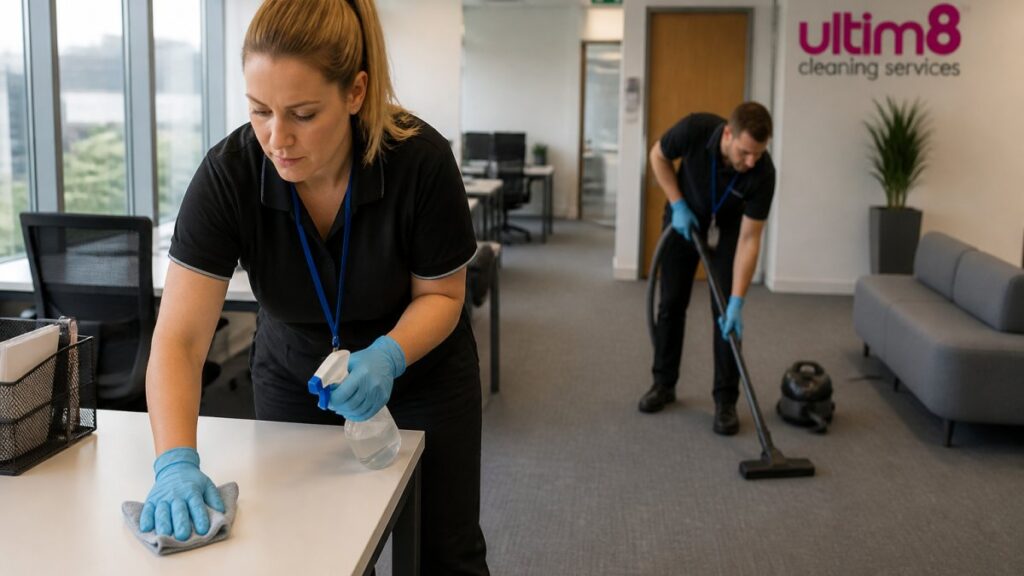
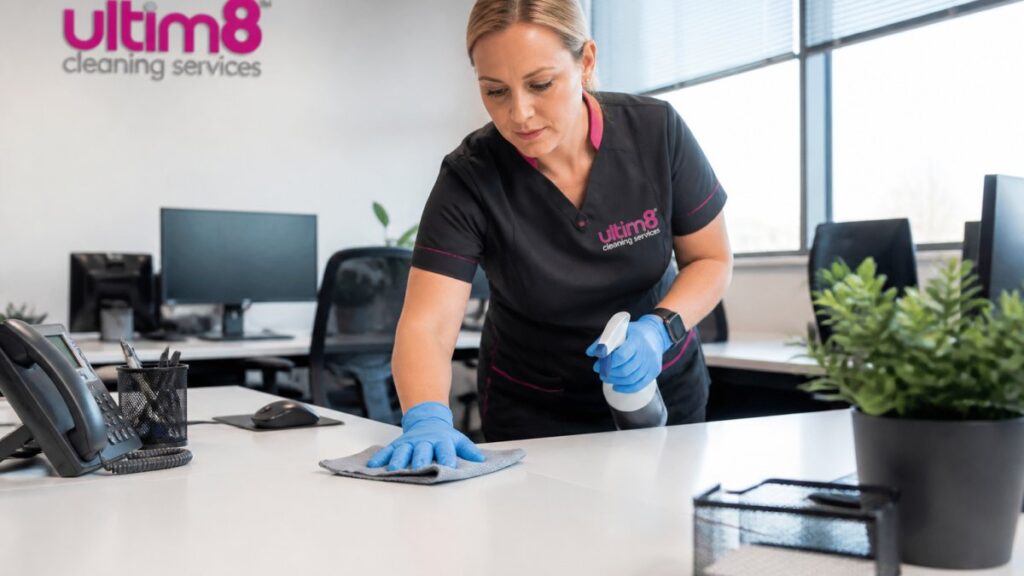
A professionally cleaned office directly impacts how your team feels at work. Regularly sanitizing high-touch surfaces, desks, conference tables, door handles, restrooms, reduces germ and virus transmission.

Beyond illness prevention, a clean workspace sends a message: “We care about you.” Clutter disappears, break rooms stay organized, restrooms are stocked.
Local providers understand your specific facility, the high-traffic hallways, the heavily used break room, the conference room where clients visit.
Professional Results and Consistent Service Quality
The difference between professional cleaning and surface-level tidying is precision. Discover what to expect from professional cleaners and the quality standards they maintain.
Consistency matters more than one-time perfection.
Ultim8 Cleaning Services trains cleaners on detailed checklists and uses high-quality, environmentally safe products. Our team is background-checked and insured, so you know who’s in your building and that you’re protected.
Understanding Commercial Cleaning Service Duties and What to Expect
When you hire local commercial cleaning services, clarity matters. Learn what is included in a standard office cleaning service to understand what you should expect.
Understanding what’s included in standard office cleaning services helps you compare providers accurately.
Ask for a detailed scope of work before signing: which areas are covered, how often, what products are used, and what happens outside the standard plan.
Cost Savings Compared with Hiring In-House Cleaning Staff
The financial case for outsourcing is real, but not automatic. Savings come from structural differences between an employee and a service contract, understanding them lets you compare quotes intelligently.
The true cost of an in-house cleaner
A single full-time cleaner is rarely just an hourly wage. Employers absorb payroll taxes, workers’ comp, unemployment insurance, paid time off, sick leave, benefits, recruiting, onboarding, screening, uniforms, equipment, supplies, and management time.
There’s also a continuity cost: when your only cleaner calls in sick or quits, the work stops until you hire and train a replacement, and that gap lands on your managers.
How a local provider changes the cost structure
A commercial cleaning contract converts fixed payroll into a variable service expense. You pay for the agreed scope and frequency; the provider carries employment, insurance, training, and staffing. If a cleaner is out, the provider covers it; if needs change seasonally, you adjust the schedule.
That said, outsourcing isn’t always cheaper. For a very small office with light needs, a part-time in-house arrangement or solo independent cleaner can pencil out lower.
What actually drives your quote
Cleaning quotes aren’t one-size-fits-all, and any provider giving a firm number without a walkthrough is guessing. Main cost drivers:
- Facility size and layout. Square footage matters, but so does density. A 5,000-square-foot open office cleans faster than the same footage of private offices and conference rooms.
- Cleaning frequency. Daily service costs more per month than three-times-weekly, but the per-visit price often drops because the space never reaches heavy-soil condition.
- Floor types and finish requirements. Carpet, tile, vinyl, and polished concrete each require different equipment and time. Stripping, waxing, and carpet extraction are usually priced separately.
How to compare quotes fairly
Ask every provider to price the same written scope. A lower bid excluding restroom restocking, floor care, or periodic deep cleaning isn’t actually lower. Request the per-visit price, monthly total, contract term, cancellation notice, and escalation clause, then compare the fully loaded in-house cost against the contract total, not the base wage.
Before you sign, ask each provider to walk you through a sample invoice. It should show the services performed, the dates, and any extras billed. A clear invoice template is a sign of a provider that tracks scope and accountability.
Local providers often have an advantage: they can visit your facility, see actual conditions, and adjust scope without a corporate approval chain, responsiveness worth weighing alongside price.
Creating a Commercial Cleaning Checklist for Your Facility
A commercial cleaning checklist is your roadmap. It documents what should be cleaned, how often, and to what standard, protecting you and your provider, eliminating guesswork, and ensuring accountability.
Start by listing all areas in your facility:
- Restrooms (toilets, sinks, mirrors, floors, stalls)
- Break rooms (appliances, tables, counters, floors)
- Office areas (desks, phones, keyboards, filing cabinets)
For each area, specify frequency, restrooms daily, office desks weekly, hallways twice weekly, then define the tasks: what products are used, what surfaces are touched, and what the finished standard looks like.
Share this checklist with your provider. Many professional teams, including Ultim8 Cleaning Services, work from detailed checklists.
Office Cleaning Frequency: How Often Should Your Workspace Be Cleaned?
Cleaning frequency depends on business type, foot traffic, and industry standards. A law office differs from a medical facility; a small startup might clean weekly, while a busy corporate campus may need daily service.
Daily cleaning works best for high-traffic areas like restrooms, break rooms, and entryways. These spaces accumulate dirt, spills, and germs quickly. Weekly cleaning typically covers office desks, conference rooms, and common areas.
Consider your industry: healthcare and food service require more frequent sanitization, retail and hospitality benefit from daily attention, and professional offices often do well with three to four times weekly. The right frequency balances cleanliness standards with budget. Local commercial cleaning services can assess your needs and recommend a schedule, often with flexible arrangements you can adjust as your business changes.
How to Choose a Commercial Cleaning Company That Fits Your Needs
Selecting a provider is a risk decision as much as a price decision. Use a checklist to evaluate cleaning companies and compare your options systematically. You’re giving a vendor recurring access to your facility, equipment, and sometimes sensitive areas. The right questions go beyond ‘are they insured’ into how coverage, screening, and accountability actually work.
Verify insurance, bonding, and licensing
Ask for a current certificate of insurance and confirm it lists general liability coverage at a limit appropriate for your facility. If the provider will have keys or alarm codes, ask whether employees are bonded and whether the company carries a janitorial or fidelity bond that responds to theft. Confirm the certificate names your business as an additional insured if your lease or risk policy requires it.
Understand staff screening and access procedures
Ask how the company screens employees: background checks, reference checks, and eligibility verification. Then ask how access is controlled. Who holds the keys? Is there a key log? How are alarm codes issued and revoked when an employee leaves? Are crews badged, and is there a sign-in procedure? A provider that cannot describe these processes clearly is a provider that has not thought about your security.
Confirm training and chemical safety
Cleaning chemicals carry real hazards. Ask how staff are trained on dilution, PPE, and safe mixing, and whether safety data sheets are available for every product used in your building. If your workplace has employees with fragrance sensitivities or respiratory concerns, ask whether low-fragrance or greener products are available and what ‘green’ means in their catalog.
Request references from similar facilities
Ask for references from businesses of similar size and type, and actually call them. Useful questions: How long have you worked with them? How do they handle a missed task? How quickly do they respond to a complaint? Has the same crew stayed on your account? A provider with stable crews and long client relationships is usually a safer bet than one with high turnover.
Insist on a written scope and service-level expectations
A strong proposal states what is cleaned, how often, to what standard, and what happens when something falls short. Ask for the inspection process: who checks the work, how often, and how findings are reported to you. Clarify the communication channel for issues, the expected response time, and the remedy if a task is missed.
Do not rely on verbal promises about coverage or response times. If it is not in the scope of work or the service agreement, it is not enforceable.
Evaluate local coverage and response capability
A local provider’s practical advantage is proximity. Ask how many crews serve your area, how quickly they can respond to an urgent request, and whether they can add a visit before a client event. Confirm the service area in writing and ask what happens during weather events or staffing shortages. A provider who can name their backup plan is more credible than one who promises it will never be needed.
Use a side-by-side comparison
Score each finalist on the same criteria: insurance and bonding, screening and access control, training and chemical safety, references, written scope, inspection and communication process, local coverage, and total price for the same scope. A checklist for evaluating cleaning companies can help you keep the comparison consistent. The goal is not the lowest bid; it is the provider whose processes you can verify and whose accountability you can enforce.
Next Steps: Get Your Office Cleaning Right
Choosing local commercial cleaning services transforms how your workspace functions. A clean office isn’t a luxury, it’s operational infrastructure. It affects employee health, morale, productivity, and how clients perceive your business.
The decision comes down to finding a provider you trust. Our team works through detailed checklists and delivers consistent, professional results. Book a cleaning service today and take back the time and energy you spend managing this yourself.
Your workspace reflects your values. When it’s clean, organized, and well-maintained, your team performs better. Clients feel respected. Employees feel cared for. That foundation matters more than most businesses realize until they experience it.
| Benefit | What It Means | Impact |
|---|---|---|
| Health & Safety | Regular sanitization of high-touch surfaces | Fewer sick days, better morale |
| Professional Results | Trained cleaners, detailed checklists, commercial equipment | Consistent quality every visit |
| Cost Efficiency | No salaries, benefits, or management overhead | Lower total cleaning costs |
| Flexibility | Adjust frequency and scope based on your needs | Scale services up or down easily |
| Accountability | Written scope of work and clear standards | Know exactly what you’re paying for |
| Local Expertise | Same team, familiar with your facility | Personalized, responsive service |
Frequently Asked Questions
What are the main benefits of hiring local commercial cleaning services?
Local commercial cleaning services provide consistent, reliable cleaning tailored to your facility’s specific needs. Key benefits include a healthier work environment with reduced germs on high-touch surfaces, improved employee productivity and morale, professional results that impress clients, and cost savings compared to hiring in-house staff. Local providers offer faster response times, personalized attention, and accountability through established relationships in your community.
How often should an office be professionally cleaned?
Office cleaning frequency depends on your facility type, foot traffic, and industry standards. Most offices benefit from daily or five-times-weekly cleaning of high-traffic areas, restrooms, and break rooms. High-touch surfaces like door handles and conference tables should be disinfected daily. Lighter maintenance areas may need weekly attention. A professional cleaning company can assess your specific needs and create a customized schedule that maintains workplace cleanliness without excess cost.
What should I look for when choosing a commercial cleaning company?
Verify that the company employs background-checked, insured, and trained cleaning staff who follow detailed checklists. Ask about their cleaning products, ensure they use high-quality, environmentally safe options if that’s a priority. Check for responsive customer service, transparent pricing, and flexible scheduling. Request references or read reviews from other local businesses. Confirm they understand your specific requirements, such as attention to high-touch surfaces or industry-specific compliance needs, and offer a satisfaction guarantee.
Are commercial cleaning services worth the cost compared to hiring in-house staff?
Yes. Outsourcing to a professional cleaning service typically costs less than hiring, training, and managing full-time janitorial employees. You avoid payroll taxes, benefits, equipment purchases, and the management burden of staffing. Professional services provide trained, vetted cleaners with commercial-grade equipment and proven processes. You pay only for the hours you need, with flexibility to adjust as your business changes. Most businesses find the time savings and operational efficiency make professional cleaning a cost-effective investment.