Is Eco Friendly Office Cleaning Worth the Cost?
September 14, 2026
Table of Contents
- Why Per-Room Pricing Beats Flat-Rate Guessing
- The Cost-Per-Room Formula: Square Footage, Labor Hours, and Base Rates
- Average Time to Deep Clean a Room (and What Drives It Up)
- What Is Included in a Deep Cleaning Service
- Factors Affecting Residential Cleaning Quotes
- DIY vs. Professional Deep Cleaning: A Cost Breakdown
- Building a Client-Ready Quote: A Room-by-Room Checklist
- Frequently Asked Questions
Last Updated: September 15, 2026
Why Per-Room Pricing Beats Flat-Rate Guessing
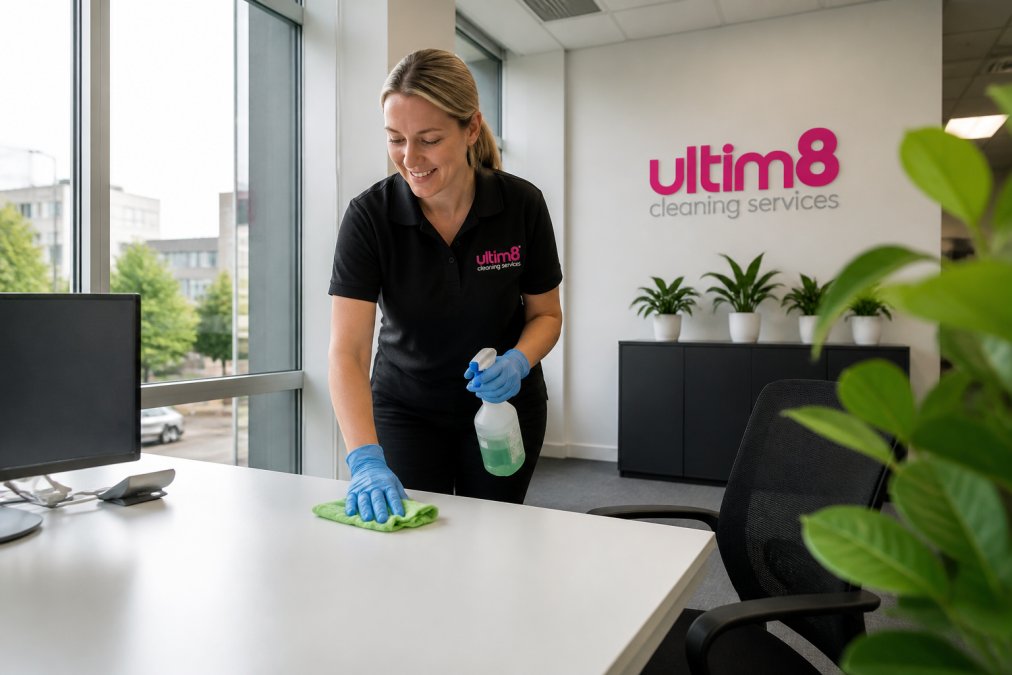
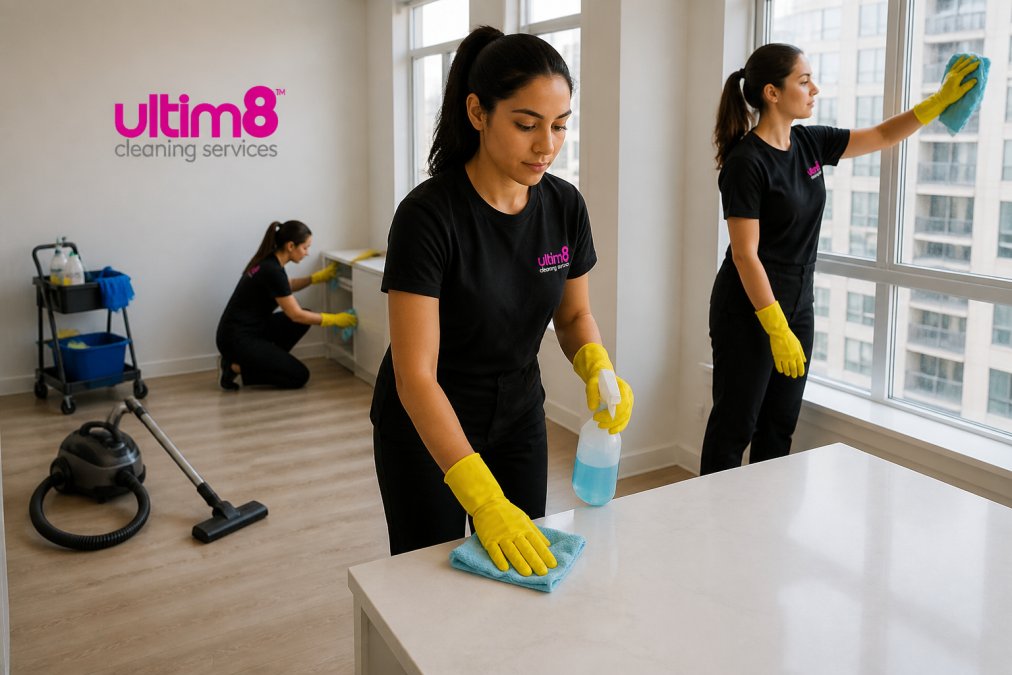
Most cleaning quotes fall apart because they start with a flat rate instead of a measurement, which is why knowing how to calculate deep house cleaning costs per room matters. Learning how to calculate deep house cleaning costs per room fixes that: you price the actual work, not a guess that collapses the moment a kitchen turns out to be 400 square feet of grease and grout. Ultim8 Cleaning Services provides professional residential and office cleaning solutions tailored to meet the needs of busy families and professionals. Our team of insured and background-checked cleaners utilizes high-quality, environmentally safe products to ensure your space is left spotless and healthy.
Flat-rate guessing fails for three predictable reasons:
- It ignores cleanable surface area, so a 200-square-foot kitchen with 40 feet of counter costs the same as an empty bedroom.
- It hides labor intensity, the single biggest cost driver in any deep clean.
- It leaves no room for complexity multipliers like heavy buildup, pet hair, or post-renovation dust.
The U.S. Bureau of Labor Statistics occupational outlook for janitors and cleaners confirms cleaning work is labor-dominated, meaning your quote lives or dies on accurate time estimates.
The Cost-Per-Room Formula: Square Footage, Labor Hours, and Base Rates
The cost-per-room formula is simple: cleanable square footage divided by a production rate gives labor hours, and labor hours multiplied by your hourly rate gives the room price. Everything else, supplies, travel, and overhead, is added on top as a percentage. Most guides stop there and hand you a calculator. This one shows the math, line by line, so you can defend every dollar on the quote.

Step 1: Measure Cleanable Surface Area
Walk each room and measure only what actually gets cleaned: floors, counters, fixtures, and reachable wall space. A 12×14 bedroom is 168 square feet of floor, but the cleanable surface area includes baseboards, window sills, and closet shelves. A common pattern is to add roughly 15-25% to the floor area to account for those vertical and detail surfaces, so that 168-square-foot bedroom prices closer to 195-210 square feet of cleanable area (How to Calculate Cleaning Times – ISSA).
Step 2: Estimate Labor Hours Per Room Type
Apply a production rate, the square footage one cleaner covers per hour, to each room. Kitchens and bathrooms carry lower production rates because of fixtures, grout, and appliance interiors; bedrooms and hallways run faster. A workload assessment per room beats a whole-house guess every time.
| Room Type | Typical Production Rate | Main Time Drivers |
|---|---|---|
| Kitchen | Lowest | Appliance interior, grout, cabinet fronts |
| Bathroom | Low | Grout cleaning, fixtures, mildew |
| Bedroom | Highest | Floor area, baseboards, closets |
| Living area | Moderate | Furniture moving, dusting, floors |
Step 3: Apply Your Local Hourly Rate
Multiply total labor hours by your hourly rate, then add supply costs, travel time, and overhead. That final number is your base rate before complexity adjustments.
Worked Example: One Kitchen, Start to Finish
Here is the full math for a single 200-square-foot kitchen with moderate grease buildup, priced at a $50 hourly rate:
- Cleanable area: 200 sq ft floor + 20% for counters, cabinet fronts, and backsplash = 240 sq ft.
- Production rate: a deep-clean kitchen runs at roughly 150 sq ft per hour, so 240 ÷ 150 = 1.6 labor hours.
- Base labor cost: 1.6 hours × $50 = $80.
- Supplies and overhead: add 15% = $12, bringing the room to $92.
- Complexity multiplier: moderate grease adds 20% = $18.40, for a quoted room price of about $110.
Run the same five lines for every room and the whole-house quote assembles itself. The client sees area, hours, rate, and adjustments instead of a mystery number, which is the single biggest reason per-room quotes get approved faster than flat rates.
Build a one-page spreadsheet with a column per room and rows for area, production rate, hours, rate, supplies, and multiplier. Once the formulas are in, a full-house quote takes minutes and stays consistent across every estimator on your team.
Average Time to Deep Clean a Room (and What Drives It Up)
The average time to deep clean a room ranges from about 45 minutes for a simple bedroom to well over two hours for a heavily soiled kitchen (angi.com). That spread, not the room’s size, is what makes per-room pricing accurate and flat-rate pricing dangerous.
Four variables push time upward:
- Property condition, a maintained home cleans faster than a neglected one.
- Buildup type, grease, soap scum, and pet hair each add scrubbing passes.
- Clutter level, surfaces must be cleared before they can be cleaned.
- Service frequency, a first-time deep clean always runs longer than a recurring service.
A common mistake is quoting from memory instead of a checklist. Time a few real jobs with a stopwatch and your estimates tighten fast.
What Is Included in a Deep Cleaning Service
A deep cleaning service is a top-to-bottom reset that covers everything a standard clean skips: baseboards, grout, appliance interiors, inside cabinets, vents, and light fixtures. Standard cleans maintain a home weekly or biweekly; deep cleans restore it.
Deep Clean vs. Standard Clean: The Scope Difference
Standard cleaning handles surfaces, floors, and bathrooms. Deep cleaning adds the labor-intensive items that take the most time:
- Baseboards, door frames, and vents wiped down
- Grout cleaning in tile and shower areas
- Appliance interior cleaning, including oven and refrigerator
- Inside-cabinet and inside-window cleaning
- Detailed dusting of blinds, sills, and fixtures
That scope difference is exactly why deep cleaning costs more per room, and why a client-ready quote must list inclusions line by line.
Factors Affecting Residential Cleaning Quotes
The factors affecting residential cleaning quotes come down to five cost buckets: labor hours, supply costs, travel time, overhead costs, and profit margin. Miss any one and your quote either loses money or loses the client.
- Labor hours, the dominant variable, driven by room count and condition.
- Supply costs, products, cloths, and equipment replacement.
- Travel time, unpaid drive time quietly erodes margin.
- Overhead costs, insurance, booking systems, and admin.
- Profit margin, typically applied last as a percentage, not baked into the rate.
Many cleaning businesses find that separating fixed costs from variable costs makes quoting faster and more consistent.
Complexity Multipliers: When a Room Costs More Than Its Square Footage Suggests
Complexity multipliers adjust the base room price when conditions add labor that square footage cannot capture. A 100-square-foot bathroom with heavy mildew can cost more than a 300-square-foot bedroom.
Apply multipliers for:
- Heavy buildup or post-renovation dust (add 20-50% to that room)
- Pet hair and dander (add 10-25%)
- Move-out or move-in cleaning with empty but filthy conditions
- Excessive clutter requiring pre-cleaning
Skipping complexity multipliers is the fastest way to lose money on a deep clean. A quote built purely on square footage will underprice every neglected home, and the crew absorbs the extra hours for free.
DIY vs. Professional Deep Cleaning: A Cost Breakdown
DIY deep cleaning saves the labor rate but costs your time, supplies, and often a rental for equipment like carpet cleaners.
| Factor | DIY | Professional |
|---|---|---|
| Out-of-pocket cost | Supplies and equipment rentals | Hourly or flat rate per room |
| Time investment | A full weekend or more | A few hours, hands-off |
| Equipment access | Limited to what you own or rent | Commercial-grade tools |
| Consistency | Varies each time | Checklist-driven every visit |
| Risk | Missed areas, damage | Insured, vetted crews |
Building a Client-Ready Quote: A Room-by-Room Checklist
Photograph each room during the walkthrough and attach the images to the quote. Clients accept per-room pricing far more readily when they can see the condition the price reflects, and it protects you if they dispute scope later.
Frequently Asked Questions
What is the 5-5-5 rule for cleaning?
The 5-5-5 rule is a time-management approach: spend five minutes tidying each of five rooms, then five minutes on a final reset. It is a maintenance habit, not a deep cleaning method. For calculating deep cleaning costs, you need actual labor hours per room, which typically range from 30 to 90 minutes depending on room type, condition, and the scope of work included.
Does the number of rooms affect deep cleaning quotes?
Yes. More rooms mean more cleanable surface area, more labor hours, and higher supply costs. A three-bedroom home with two bathrooms takes longer than a one-bedroom apartment even if total square footage is similar, because kitchens and bathrooms carry higher labor intensity per square foot. When requesting a quote, list each room and its condition so the cleaner can estimate accurately.
What factors increase the cost of a deep house cleaning service?
Key factors include property condition (heavy buildup, pet hair, post-construction dust), the number of bathrooms and kitchens, add-ons like inside appliances, baseboards, and grout cleaning, and whether the home is occupied or vacant. Move-out cleanings often cost more because they require a full top-to-bottom reset. Frequency also matters: recurring service typically costs less per visit than a one-time deep clean.
How do I estimate labor time for a deep clean if I have never hired a cleaner before?
Start with a baseline: a standard bedroom takes about 30 minutes, a bathroom 45 to 60 minutes, and a kitchen 60 to 90 minutes for a deep clean. Multiply by the number of rooms, then add 20 to 30 percent for homes with heavy buildup or lots of decorative items. Ask the cleaning company to walk through the home or review photos so they can give you a realistic estimate.
Deep cleaning quotes only work when the math behind them is real, and most homeowners never see that math until the price changes. Ultim8 Cleaning Services builds every estimate from measured square footage, estimated labor hours, and a transparent room-by-room breakdown, backed by insured, background-checked cleaners and instant online booking. Get a client-ready quote from Ultim8 Cleaning Services and know exactly what your deep clean costs before anyone picks up a mop.