
How to Declutter a Workspace Effectively
October 31, 2026
Last Updated: October 31, 2026
Quick Summary
You need a professional move out cleaning when two or more spots on a landlord walkthrough test fail, such as baked-on oven grease, gray dust on door frames, or dull blinds. Move out cleaning prepares an empty property for inspection, so book it after your belongings are out but before the final walkthrough.
- A deep clean refreshes a lived-in home, while move out cleaning prepares an empty property for someone else’s inspection.
- Move out cleaning often takes several hours for a standard apartment, and longer for larger or neglected homes.
- DIY is realistic if you answer yes to all six decision checklist items, including two full days before the walkthrough.
- Angi puts move out cleaning around $120 to $420, while Housecall Pro reports $220 to $400 for a typical deep clean.
- Photograph every room and appliance after belongings are out but before cleaning begins to document condition.
Table of Contents
- Signs You Need a Professional Move Out Cleaning
- Deep Cleaning vs Move Out Cleaning: What’s the Difference?
- Your Move-Out Cleaning Checklist: The Areas Landlords Inspect
- How Long Does Move Out Cleaning Take?
- DIY Move Out Cleaning: When It Works and When It Doesn’t
- What Move Out Cleaning Costs and How to Vet a Service
- Book Your Move Out Cleaning and Protect Your Deposit
- Frequently Asked Questions
Signs You Need a Professional Move Out Cleaning
The signs you need a professional move out cleaning usually show up before you notice them: grease baked onto an oven door, dust packed into window tracks, scuff marks you have stopped seeing.
Here is the part most renters learn too late. Landlords do not grade your cleaning effort.
Below, we walk through the specific signs, the difference between a deep clean and a move out cleaning, and a checklist you can run against your own place tonight.
The Walkthrough Test: Would You Pass a Landlord Inspection?
Most move out cleaning decisions come down to one question: would this space pass a landlord inspection today? If you hesitate, that hesitation is your answer.
Landlords and property managers tend to look at the same short list of spots during a final walkthrough. Dust on blinds and grime in window tracks are classic inspection points, according to Tidy’s move-out checklist, because both are visible from across a room. Kitchen appliances and cabinets get close attention for grease, crumbs, and residue, per ConsumerAffairs’ moving housecleaning checklist.
Run this five-minute self-test:
- Open the oven. Can you see baked-on grease on the door glass or racks?
- Run a finger along the top of a door frame. Does it come away gray?
- Look at the blinds from the doorway. Are the slats dull with dust?
- Smell the fridge and the garbage disposal area.
Two or more “yes” answers means you are looking at a professional job, not a Saturday afternoon. If you want the full picture of what landlords check in this state, our guide to move-out cleaning in Florida covers the walkthrough in detail.
Deep Cleaning vs Move Out Cleaning: What’s the Difference?
A deep clean refreshes a home you are living in.
Once furniture and personal belongings are gone, every surface you never saw is exposed: the dust line behind the couch, the scuffed baseboard, the cabinet interiors.
Move out cleaning often adds:
- Appliance interiors, including oven, fridge, and microwave
- Inside cabinets and closets
- Baseboards, doors, and trim throughout
- Window sills and tracks
- Hard-to-reach areas normally blocked by furniture
If you want to know exactly what a deep clean covers so you can compare the two, our breakdown of what is included in a deep house cleaning spells it out.
Your Move-Out Cleaning Checklist: The Areas Landlords Inspect
This move-out cleaning checklist follows the order inspectors tend to walk: kitchen first, then bathrooms, living areas, and finally floors and trim. Work top to bottom in each room so you are not cleaning the same floor twice.
Kitchen: Grease, Crumbs, and Appliance Interiors
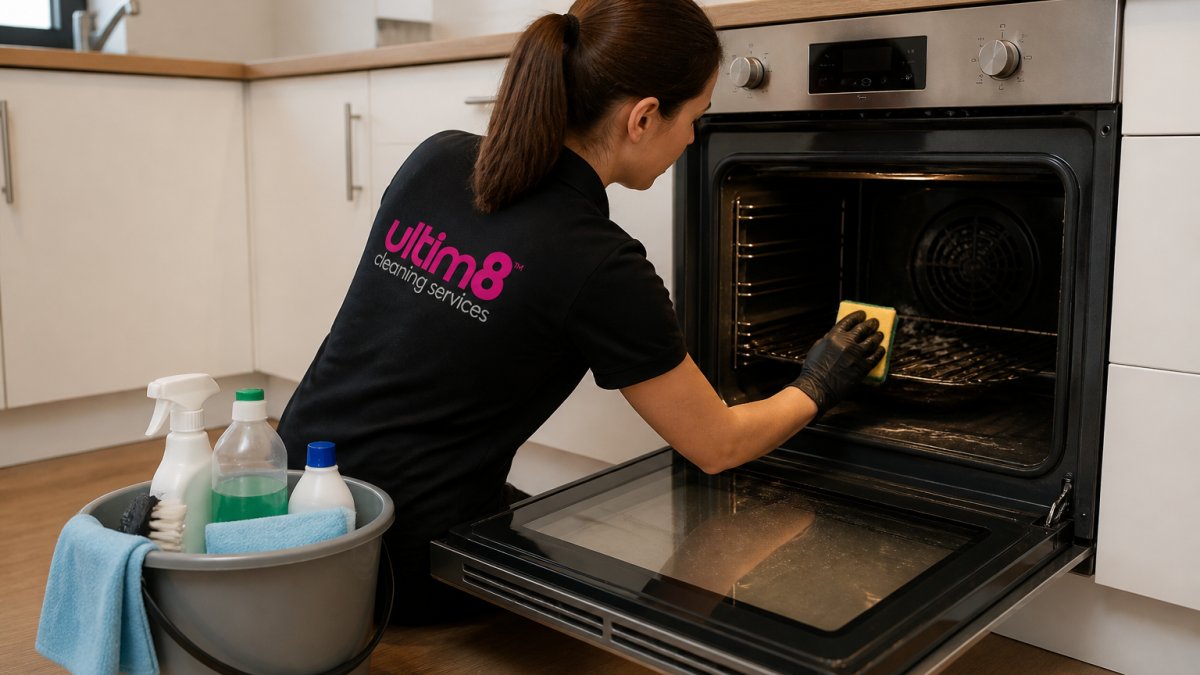
The kitchen is where move out cleaning jobs are won or lost. Grease hides above the cabinets, behind the stove, and on the range hood filter, and it reads as neglect to an inspector.
Wipe down cabinet fronts and interiors, scrub the stovetop drip pans, and pull the fridge out to clean behind it. Crumbs collect in drawer corners and along the door gaskets.
Bathrooms, Bedrooms, and Living Areas
Bathrooms need descaling, not just wiping. Mineral buildup on glass, grout discoloration, and grime around fixtures are the stubborn spots that separate a surface clean from an inspection-ready one.
In bedrooms and living areas, focus on dust buildup along the ceiling line, inside closets, and on outlet covers. Empty every space completely, including the garage and any storage nook, so nothing of yours gets left behind.
Floors, Baseboards, Doors, and Trim
Floors, baseboards, doors, and trim take the most visible wear, and they are the last thing an inspector sees on the way out.
Wipe down door faces and frames, clean light switch plates, and vacuum or mop right to the wall line. For a fuller room-by-room list you can follow while cleaning, use our residential deep cleaning checklist for move outs.
How Long Does Move Out Cleaning Take?
A move out cleaning often takes several hours for a standard apartment, and longer for a larger home or one that has not had a deep clean in a while. The empty unit is the wildcard: once furniture is out, hidden work appears.
Plan on the upper end if any of these apply:
- The home has pets or has been smoked in
- The oven or fridge has never been deep cleaned
- There is damage beyond normal wear and tear
- You are cleaning alone rather than with a crew
Build the cleaning into your moving schedule before the final walkthrough, not the morning of it. Rushing is how deposits get lost.
DIY Move Out Cleaning: When It Works and When It Doesn’t
DIY move out cleaning is not a binary choice.
Run this decision checklist before you buy a single sponge:
- Do you have at least two full days between your last moving day and the final walkthrough?
- Is the unit under roughly 1,000 square feet with no pets, no smoking, and no long-deferred maintenance?
- Have you deep cleaned the oven, fridge, and window tracks at least once in the past year?
- Do you own or can you cheaply rent a vacuum with attachments, a mop, and a steamer?
- Is your lease free of specific cleaning requirements (carpet shampooing, professional receipt, etc.)?
If you answered yes to all six, DIY is realistic. If you answered no to two or more, the math usually favors hiring.
The tasks that most often break a DIY plan are predictable:
- Oven and fridge interiors. Baked-on grease and food residue can take an hour or more each without commercial degreasers.
- Window tracks and blinds. These are slow, detailed work that inspectors notice immediately.
- Baseboards and door frames. Easy to underestimate; a whole unit can take several hours.
- Carpet and grout. Without a rented extractor or steamer, results often fall short of inspection standard.
- Pet hair and odor. Hair embeds in upholstery and vents; odor lingers in places a surface clean will not reach.
If you are leaning toward hiring, use the next section to compare quotes and vet the service. If you are leaning toward DIY, build a written task list from your lease’s cleaning addendum and photograph each completed area as you go, that documentation is your protection if the walkthrough disputes arise.
What Move Out Cleaning Costs and How to Vet a Service
Professional move out cleaning generally falls in a broad range, and the price moves with home size, condition, and how deep the clean needs to go. Angi’s move-out cleaning cost guide puts the figure around $120 to $420 for most jobs, while Housecall Pro’s house cleaning pricing guide reports a typical move-in or move-out deep clean at $220 to $400 based on its customer data.
Pricing models vary, and knowing which one you are quoted matters more than the headline number:
- Flat-rate by size and condition. Most common for move outs; the quote is fixed after a walkthrough or photos.
- Hourly with an estimate. Common for smaller units; the final bill depends on actual hours, so ask for a not-to-exceed cap.
- Room-by-room or add-on pricing. Base price covers standard areas; appliances, windows, carpets, and garages are add-ons.
- Deposit-back guarantee or re-clean clause. Some services will return if the landlord flags an item within a set window; confirm the terms in writing.
Before you book, verify these items:
| What to Check | Why It Matters |
|---|---|
| Written scope of work | Confirms appliance interiors, trim, and window tracks are included |
| Insurance and background checks | Protects you if something breaks or goes missing |
| Flat quote vs. hourly | Prevents surprise charges on a big unit |
| Deposit or guarantee policy | Tells you what happens if something is missed |
| Reviews mentioning move-outs | Shows they handle empty units, not just routine visits |
| Supplies and equipment included | Clarifies whether you pay extra for specialty products |
| Re-clean window after inspection | Defines how quickly they will return if the landlord flags an item |
Rental-Specific Requirements and Deposit Documentation
Cleaning and damage are different categories in most leases, and confusing them is how deposits get disputed. Before you book anyone, pull your lease and any move-out instructions and compare them line by line against the service’s scope. Look specifically for:
- Required professional carpet cleaning or receipt requirements
- Named cleaning standards (for example, “oven free of grease” or “blinds dust-free”)
- Appliance and fixture expectations
- Trash removal and utility shut-off responsibilities
- Deadline for the final walkthrough and condition report
Document condition before and after. A practical sequence:
- Photograph every room, appliance interior, and floor after your belongings are out but before cleaning begins.
- Note pre-existing damage in writing and, if possible, have the landlord acknowledge it.
- After cleaning, photograph the same angles and keep the cleaning invoice with the scope attached.
- Attend the walkthrough if allowed, and ask the landlord to note any disputed item in writing.
This documentation does two things: it separates cleaning issues (which a re-clean can fix) from damage (which cleaning cannot), and it gives you evidence if a deposit deduction is challenged. If your lease requires a professional receipt, confirm the service will provide one with the scope itemized.
For a closer look at how quotes are built, see our cleaning services cost guide.
Book Your Move Out Cleaning and Protect Your Deposit
The deposit you are trying to protect is usually worth more than the cleaning bill, which is why the timing matters as much as the service.
At Ultim8 Cleaning Services, our insured and background-checked cleaners work through detailed checklists. We use environmentally safe products, and you can book online with flexible scheduling.
If you are ready to hand off the hardest part of moving, get an instant quote for house cleaning and see what to expect when you request one.
Frequently Asked Questions
What are the signs you need a professional move out cleaning?
The clearest signs are visible dust on blinds and grime in window tracks, grease and crumbs in kitchen appliances and cabinets, and stains or dust buildup in corners you have not touched in months. If your final walkthrough is within a week and those areas still look worn, a professional move out cleaning is the safer call. Landlords check these spots closely, and a missed detail can cost you part of your security deposit.
Is professional move out cleaning worth it?
It often is when your lease requires a specific standard or your deposit is on the line. Compare that with the deposit you stand to lose over a failed inspection. If you are short on time, have a large home, or are juggling a moving schedule, paying for a checklist-driven clean usually costs less than the dispute.
How long does move out cleaning take?
How long move out cleaning takes depends on square footage, condition, and whether the home is empty. A small, well-kept apartment may finish in half a day, while a larger home with heavy buildup can run longer. Book before your furniture removal is complete so cleaners can reach floors, baseboards, and hard-to-reach areas without moving boxes around.
What is the difference between deep cleaning and move out cleaning?
Deep cleaning covers the detailed work inside a lived-in home, such as scrubbing grout, wiping cabinet interiors, and cleaning appliance insides. Move out cleaning goes further because the home is empty and inspection-ready: it targets the areas a landlord checks during the final walkthrough, including window sills, doors and trim, and any neglected areas behind furniture. Think of move out cleaning as deep cleaning built around lease requirements.