
Signs You Need Professional Move Out Cleaning: A Room-by-Room Guide
November 1, 2026
Last Updated: November 1, 2026
Quick Summary
To vet professional house cleaning companies, build a written checklist first and confirm insurance, bonding, and background screening before anyone enters your home. Then compare written estimates on identical terms, call local references, and get a room-by-room scope in writing before the first visit.
- Request the certificate of insurance from the insurer or agent, not the cleaning company’s sales inbox.
- Ask about general liability, workers’ compensation, and bonding by name, since they are not interchangeable.
- Read three-star reviews first for specific patterns like late arrivals and missed bathrooms.
- Convert every quote to price per visit at your chosen frequency before comparing totals.
- Skip any company that refuses an on-site walkthrough before quoting.
Table of Contents
- Start With a House Cleaning Service Checklist Before You Call Anyone
- Verify Cleaning Company Insurance and Bonding Before Anyone Enters Your Home
- Check Credentials, Background Screening, and Real Customer Reviews
- The Questions to Ask a Cleaning Service That Reveal How They Actually Operate
- Understand House Cleaning Estimates and Pricing So You Compare Quotes Fairly
- Request References and Run a Real On-Site Walkthrough
- Written Scope, Exclusions, and Service Agreements: Get It in Writing
- Spot Red Flags and Protect Your Home Security
- Frequently Asked Questions
Start With a House Cleaning Service Checklist Before You Call Anyone
Vetting professional house cleaning companies works best when you build a checklist first and make calls second. A written list keeps you from getting swept up by a friendly phone voice and a low opening quote.
The company that answers your questions clearly and in writing is more likely to deliver a thorough clean than one that stays vague.
What Belongs on Your Vetting Checklist
A house cleaning service checklist is a one-page list of what you must confirm before anyone enters your home. Keep it short enough to use during a five-minute call.
- Legal business name and local address
- General liability insurance, with a certificate you can see
- Bonding that covers theft by staff
Print it and fill it in for each company you consider.
Verify Cleaning Company Insurance and Bonding Before Anyone Enters Your Home
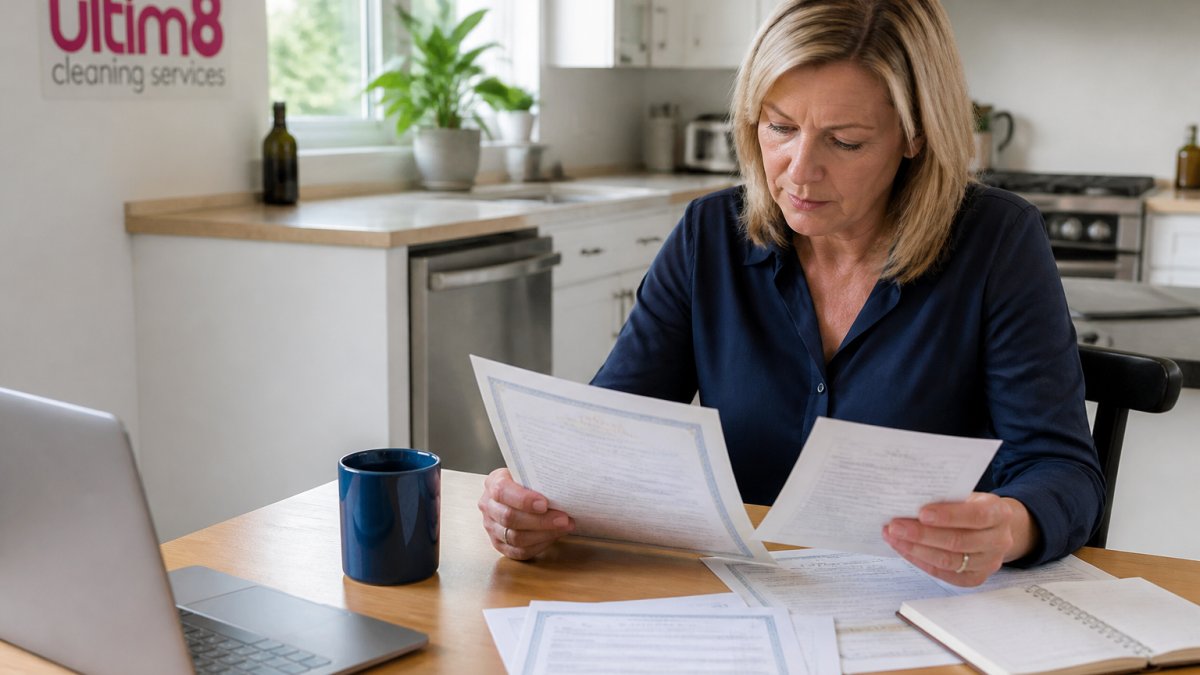
Cleaning company insurance and bonding is the part most homeowners skip, and it is the part that matters most. Insurance covers damage to your property. Bonding covers theft.
The Three Coverages That Matter and What Each One Does
A legitimate cleaning company typically carries three separate protections. Ask about each one by name, because they are not interchangeable:
- General liability insurance covers accidental damage to your property, a knocked-over lamp, a scratched floor, a stained countertop, and bodily injury to a third party. This is the policy that pays when a cleaner accidentally damages your home.
- Workers’ compensation insurance covers medical costs and lost wages if a cleaner is injured while working in your home. Without it, an injured worker could look to you, the homeowner, for medical bills. This is the coverage homeowners most often forget to ask about.
- Bonding is a separate policy, sometimes called a fidelity bond, that protects you against theft by an employee. It is not the same as insurance and does not cover damage, it covers dishonesty.
A company can be insured but not bonded, or bonded but not carrying workers’ compensation. Ask for all three in writing.
How to Actually Verify a Certificate of Insurance
A certificate of insurance (COI) is a one-page summary an insurer or agent issues. A salesperson can email you a PDF, but that does not prove the policy is active. Verify it in four steps:
- Request the COI directly from the insurer or agent, not from the cleaning company’s sales inbox. Ask the company for its agent’s contact information and request the certificate yourself.
- Match the named insured on the certificate to the exact legal business name you are hiring. A certificate for a different entity, a parent company, a franchise, or an individual, may not cover the crew in your home.
- Check the policy dates. The effective and expiration dates must cover your scheduled service date. A certificate that expired last month proves nothing.
- Call the agent and confirm the policy number is active and in force. This is the step most homeowners skip, and it is the only way to catch a canceled or lapsed policy.
A forwarded PDF is not proof. Certificates are easy to alter, and a lapsed policy still produces an old certificate. Always confirm the policy number with the insurer or agent by phone before the first cleaning.
What to Ask About Damage, Injury, and Claims
Coverage only helps if the claims process works. Ask these questions before booking:
- If something is damaged, what is your claims process, and who do I contact?
- Does your general liability policy cover damage caused by your employees while working in a customer’s home?
- Are all cleaners, including part-time and temporary staff, covered by your workers’ compensation policy?
Get the answers in writing, and keep the certificate and your notes with your service agreement.
Check Credentials, Background Screening, and Real Customer Reviews
Credentials come in layers: business registration, insurance, bonding, and staff screening. Ask how the company screens cleaners, when screening happens, and whether it repeats. How to verify background checked cleaners walks through the steps.
Reviews are the second layer. Read the three-star reviews first, not the five-star ones. Three-star reviews tend to be specific and fair. Look for patterns: late arrivals, missed bathrooms, high staff turnover.
The Questions to Ask a Cleaning Service That Reveal How They Actually Operate
The right questions to ask a cleaning service are operational, not sales. Ask how a team plans to complete the work in the time quoted.
Scope, Products, and Scheduling Questions
Ask these directly:
- What exactly is included in a standard cleaning, room by room?
- What costs extra, and how much notice do you need for add-ons?
- Which products do you use, and can you send the list?
Listen for specifics. “We clean everything” is not an answer. A real answer names edges, baseboards, inside the microwave, and door handles. If you work from home, ask how the team handles occupied rooms. A good crew works around you quietly and does not need managing.
Understand House Cleaning Estimates and Pricing So You Compare Quotes Fairly
House cleaning estimates and pricing vary by size, condition, frequency, and scope, so compare quotes on identical terms. The trap is that two quotes for the “same” house can describe completely different jobs.
Build a Quote Request Sheet First
Before you call anyone, write down the inputs every company needs so each quote is based on the same facts:
- Square footage and number of bedrooms and bathrooms
- Number of occupants and pets
- Current condition (recently cleaned, lived-in, or post-renovation)
- Frequency you want (weekly, biweekly, monthly, one-time)
Send the same sheet to every company. If one company quotes without asking about pets or condition, its number is a guess, not an estimate.
Normalize Each Quote Before You Compare
Once quotes come back, convert each one to the same unit so you are comparing apples to apples:
- Price per visit, not per hour. Hourly rates hide minimum-hours charges. Ask what the total charge will be for one visit at your frequency.
- Price per clean at your chosen frequency. A biweekly rate is not comparable to a weekly rate. Ask each company for the same frequency.
- Included tasks versus add-ons. List every task in your sheet and mark whether each quote includes it or charges extra. A lower base price with three add-ons can cost more than a higher all-inclusive quote.
- Supplies and equipment. Confirm whether products, vacuums, and mops are included or billed separately.
Put each quote into a simple grid: company name, price per visit at your frequency, tasks included, tasks extra, supplies included, and fees. The lowest number in the first column is rarely the lowest total in the last.
Quote Traps to Watch For
- A low hourly rate paired with a minimum-hours charge that exceeds the actual job
- Add-on fees for tasks other companies include in the base price
- First-visit discounts that vanish on visit two
- No written estimate at all, or an estimate with no expiration date
Get It in Writing, With a Validity Period
Ask each company for a written estimate, valid for a set period, that covers recurring cleaning, deep cleaning, and move-out cleaning separately. The written estimate should state the price per visit, the frequency, the included task list, the add-ons and their prices, the fees, and the cancellation terms. If a company will not put the number in writing, treat the quote as marketing, not pricing.
Ask each company for a written estimate before you call.
Request References and Run a Real On-Site Walkthrough
References and a walkthrough are where phone promises meet reality. Ask for two or three recent local customers, ideally with homes similar to yours.
Then ask for an on-site assessment. A walkthrough lets the company see your home and quote accurately. Notice whether they ask about your home’s layout, pets, or fragile items.
Skip the walkthrough and you are guessing. A company that refuses one before quoting is quoting blind.
Written Scope, Exclusions, and Service Agreements: Get It in Writing
A written scope is the single best protection you have. It should list every room, every task, and every exclusion. It should state the price, the schedule, the cancellation policy, and how complaints are handled.
Insist on these items in the agreement:
- Room-by-room task list, including high-traffic areas
- Clear exclusions, such as biohazards or heavy lifting
- Products used, and whether they are pet-friendly
- Access instructions and alarm codes
Get it by email before the first visit.
Spot Red Flags and Protect Your Home Security
Red flags are usually small and easy to explain away. Do not. Treat each one as a data point.
- Cash-only payment with no receipt
- No physical address or business registration
- Pressure to book today for a discount
- Refusal to provide insurance proof
Home security deserves its own plan. Safety tips for letting cleaners into your home can help you build one. Confirm staff screening in writing. Keep valuables in a safe, and meet the first crew in person. Our team is insured, background-checked, and trained to work through detailed checklists.
| Vetting Step | What to Confirm | Why It Matters |
|---|---|---|
| Insurance and bonding | Certificate from the insurer | Covers damage and theft |
| Screening | Written screening policy | Protects your family and home |
| Written scope | Room-by-room task list | Prevents disputes |
| References | Two or three local customers | Shows real track record |
| Written estimate | Itemized, valid pricing | Fair quote comparison |
Frequently Asked Questions
How do I know if a house cleaning company is reputable?
Check three things: verified customer reviews on Google or Yelp, proof of insurance and bonding, and whether the company will provide references from current clients. A reputable house cleaning company will answer these questions without hesitation. Look for consistent review patterns over time, not just a high star rating. Ask whether the same team will clean your home each visit and how they screen employees. Companies that use trained staff, written checklists, and clear service agreements are easier to trust than those that dodge basic questions.
What should a house cleaning estimate include?
A complete house cleaning estimate should list the specific tasks covered, the frequency of service, any additional fees for deep cleaning or move-out cleaning, and whether supplies are included. Ask if the quote is flat-rate or hourly, and what triggers extra charges. Request the estimate in writing so you can compare it line by line with other quotes. Transparent pricing shows exactly what you pay before the team arrives, which prevents surprise charges after the first clean.
Should I check references before hiring a house cleaner?
Yes. Ask for two or three references from clients with homes similar to yours, ideally ones using recurring cleaning service. Call them and ask about reliability, communication, and whether the team consistently hits the same standard. References reveal how a company handles problems, not just how well they clean on a good day. If a company refuses to share references, treat that as a red flag and move on to another provider.
What happens if I’m unhappy with the cleaning service?
Ask about the satisfaction policy before booking. A professional house cleaning company should have a written re-clean policy for reporting missed areas. Get the policy in writing as part of your service agreement. If a company has no stated policy, or only offers verbal assurances, that is a sign the quality standards are not backed by a real process.
Hiring a cleaner should not feel like a gamble. Ultim8 Cleaning Services makes vetting simple: insured and background-checked cleaners, environmentally safe products, instant online booking, and teams trained to work through detailed checklists. Get started with Ultim8 Cleaning Services and book a clean you can actually verify.