
How to Implement a Weekly Office Cleaning Schedule
October 29, 2026
Last Updated: October 28, 2026
Quick Summary
To calculate office cleaning costs per square foot, divide the price per visit or the monthly cost by the cleanable area. Measure only the space that is actually cleaned, not total building area, because including unused areas makes the rate look artificially low.
- Measure only cleanable square footage, excluding stairwells, mechanical rooms and areas cleaned by someone else.
- Estimate labor hours by dividing cleanable square footage by a production rate, then add setup and travel time.
- Build the full cost from labor, supplies, equipment, overhead and margin before dividing by square footage.
- Normalize every quote to the same basis: cleanable area, visits per month, task scope and fully loaded rate.
Table of Contents
- Why Cost Per Square Foot Is the Most Useful Starting Point
- Step 1: Measure Cleanable Square Footage, Not Total Building Area
- Step 2: Estimate Time for Commercial Cleaning Using Production Rates
- Step 3: Apply Labor, Supplies, Overhead, and Margin
- Factors Affecting Office Cleaning Quotes
- Average Commercial Cleaning Cost Per Square Foot: Benchmarks to Check Against
- Building a Commercial Cleaning Price List Template You Can Reuse
- Booking a Cleaning Estimate for Your Office
- Frequently Asked Questions
Why Cost Per Square Foot Is the Most Useful Starting Point
Cost per square foot is the price you pay for each square foot of cleanable space, and it is the clearest way to judge office cleaning costs across different buildings. Housecall Pro’s commercial cleaning pricing guidance uses this same formula, Housecall Pro commercial cleaning pricing guidance.
Use it as a starting point, not a final answer. A rate per square foot tells you little until you know which square feet are being cleaned and how often.
Step 1: Measure Cleanable Square Footage, Not Total Building Area
Start with the square footage that actually gets cleaned. Total building area includes stairwells, mechanical rooms, and areas a janitor never enters. Using that bigger number makes your rate look artificially low.
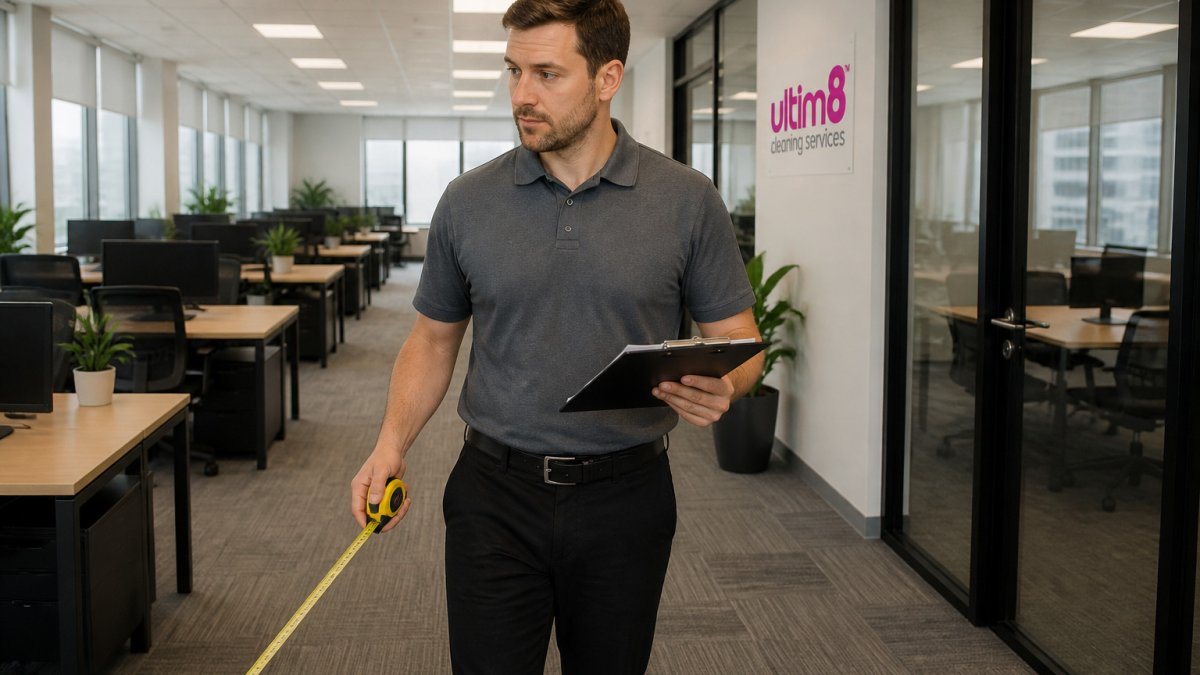
Measure in this order:
- Open office floor space and private offices
- Conference rooms and break rooms
- Restrooms and kitchens
- Lobbies, hallways, and entry areas
Exclude spaces that are locked, leased to another tenant, or cleaned by someone else. Write down the total for each floor so you can revisit it when the lease changes.
Step 2: Estimate Time for Commercial Cleaning Using Production Rates
Labor usually drives most of the cost, so it is the main factor behind office cleaning costs. A production rate estimates how many square feet one cleaner can handle in an hour.
To estimate hours:
- Divide the cleanable square footage by your production rate.
- Add setup time, restocking, and travel between floors.
- Multiply the result by the number of cleaners on the job.
Compare the result with your rough pricing from the first section. If the hours don’t fit, your rate per square foot is likely too low. For guidance on setting up a recurring weekly routine these hours are based on, see how to set up a recurring weekly office cleaning schedule.
Step 3: Apply Labor, Supplies, Overhead, and Margin
Labor hours are only one piece. Build the full cost in layers:
- Labor: Hours multiplied by the hourly wage, plus payroll taxes and insurance
- Supplies: Cleaning chemicals, liners, paper products, and microfiber
- Equipment: Vacuums, floor machines, and their maintenance
- Overhead: Scheduling, insurance, background checks, and administration
- Margin: The profit the business needs to stay healthy
Divide the total by the cleanable square footage. That gives you a fully loaded cost per square foot you can compare against quotes. To see what a commercial office cleaning service typically includes and how it is scoped, read what a commercial office cleaning service includes.
Watch out: leaving out payroll taxes and insurance is the most common reason a bid looks cheap and then loses money.
Factors Affecting Office Cleaning Quotes
Two offices of the same size can receive very different quotes. The drivers below are the ones that move the number most, and each one is framed as a mechanism you can test against a real bid rather than a label to accept at face value.
Cleaning frequency and the visit multiplier
Frequency is the single largest lever on monthly cost. A per-visit rate multiplied by visits per month gives the monthly price, so moving from three visits per week to five raises the monthly bill by roughly two-thirds even if the per-visit rate is unchanged. Many vendors also discount the per-visit rate at higher frequency because setup and travel are spread across more visits.
Cleanable area versus total building area
Quotes are sometimes built on total building area because it is easier to obtain from the lease. That inflates the billable square footage with storage rooms, mechanical spaces, vacant suites, and shared areas outside the contracted scope. Confirm in writing which square footage the rate is applied to, and reconcile it against your own cleanable-area measurement. A 10% difference in billable area is a 10% difference in price at the same rate.
Scope and service level
Routine office cleaning, trash, dusting, vacuuming, restroom and break-room service, is priced differently from periodic work such as carpet extraction, floor stripping and waxing, window cleaning, and post-construction cleanup. Those periodic tasks are often quoted per event or per square foot and billed separately. A quote that bundles them into the monthly rate is not necessarily cheaper; it may simply be hiding a line item you would otherwise compare.
Labor-hour realism and production rate
A quote is operationally realistic only if the labor hours fit the space. Divide cleanable square footage by the vendor’s stated production rate to estimate hours per visit, then multiply by the crew size and compare with the quoted price. If a quote implies far fewer hours than the scope requires, either the scope is thinner than described or the vendor is underpricing the job, both are risks. This cross-check is the fastest way to spot a bid that will not survive its first month.
Facility type and surface count
Medical offices, dental suites, and labs carry additional procedure and documentation requirements that raise labor time per square foot. Standard offices with dense high-touch surfaces, door handles, shared desks, conference tables, elevator buttons, also take longer per square foot than open floor plates with sparse furniture. Count the high-touch points and restrooms per floor; restroom count per square foot is one of the strongest predictors of labor time in office cleaning.
Access, schedule, and security
After-hours work, escorted access, badging requirements, and tight cleaning windows all add cost because they reduce the productive minutes in a shift. A building that requires a security escort after 6 p.m. effectively pays for two people instead of one. State your access constraints in the request for quote so vendors price them explicitly rather than discovering them later.
Cost components beyond labor
Labor typically dominates, but supplies, equipment maintenance, insurance, background checks, scheduling and administration, travel between accounts, and profit margin all sit inside the rate. A bid that omits payroll taxes and insurance is the most common reason a quote looks cheap and then loses money. Ask vendors to confirm whether the rate is fully loaded, meaning it includes payroll taxes, workers’ compensation, general liability insurance, supplies, and equipment, or whether any of those are billed separately.
Contract and billing details
Confirm whether the quoted rate is per visit, per month, or per square foot per month, and whether there is a minimum monthly charge, a one-time setup or startup fee, and a price-adjustment clause tied to wage changes or inflation. These terms change the effective rate more than most buyers expect, and they are the details that make two superficially similar quotes genuinely comparable.
When you compare quotes, normalize every bid to the same basis: cleanable square footage, visits per month, task-by-task scope, and fully loaded rate. The vendor with the lowest headline number is not always the lowest cost once frequency, scope, and billing terms are aligned.
Average Commercial Cleaning Cost Per Square Foot: Benchmarks to Check Against
Benchmarks are only useful if you know what they measure. A per-visit price, a per-square-foot-per-month rate, and a per-square-foot-per-visit rate are three different numbers, and mixing them is the fastest way to misjudge a quote. Before you compare anything, confirm the basis: is the figure per visit, per month, or per square foot per month?
How to read a per-square-foot benchmark
Most published office cleaning benchmarks are expressed as a rate per square foot per month for recurring service.
To translate a benchmark into a monthly figure for your space:
- Multiply cleanable square footage by the benchmark rate per square foot per month.
- Compare the result with the vendor’s quoted monthly price.
- Divide the monthly price by the number of visits to get a per-visit figure.
- Divide the per-visit figure by cleanable square footage to get a per-square-foot-per-visit rate.
Worked example: 10,000 cleanable square feet at $0.10 per square foot per month equals $1,000 per month. At 20 visits per month (roughly five per week), that is $50 per visit, or $0.005 per square foot per visit. If a vendor quotes $1,400 per month for the same scope, the implied rate is $0.14 per square foot per month, still inside the band, but you now know exactly where it sits.
Per-visit benchmarks and why they mislead
Per-visit figures are common in consumer-facing pricing content. One widely cited example is a national average commercial cleaning cost of $161 to $402 per visit, with most customers paying about $253, per Thumbtack. That range is useful for a one-time or occasional job, but it says nothing about frequency, scope, or square footage, so it cannot be compared directly with a recurring per-square-foot rate. A $253 visit on a 2,000-square-foot office is a very different deal than a $253 visit on a 20,000-square-foot floor.
Never compare a per-visit benchmark with a per-square-foot-per-month quote without converting both to the same basis. The conversion is simple arithmetic, but skipping it is the most common source of bad comparisons.
What the benchmarks do not tell you
Published ranges rarely state whether they include supplies, equipment, payroll taxes, insurance, or periodic work such as carpet extraction and floor stripping. A rate that looks low may exclude restroom consumables; a rate that looks high may bundle quarterly deep cleans.
Use the benchmark to flag outliers, then use your own cleanable square footage, frequency, and scope to decide whether a quote is reasonable.
Building a Commercial Cleaning Price List Template You Can Reuse
A reusable template saves time on every new bid. Create one sheet with these columns:
| Line Item | Input | Formula | Example Result |
|---|---|---|---|
| Cleanable sq. ft. | 10,000 | Measured | 10,000 |
| Production rate | 2,000 sq. ft./hr | Assumed | 2,000 |
| Labor hours per visit | 5 | Sq. ft. ÷ rate, plus setup | 5.5 |
| Labor cost | $22/hr | Hours × wage × 1.25 | $151 |
| Supplies per visit | $18 | Estimate | $18 |
| Overhead and margin | 25% | (Labor + supplies) × 1.25 | $211 |
| Cost per visit | Sum | $211 | |
| Cost per sq. ft. | Cost ÷ sq. ft. | $0.021 |
Replace the sample inputs with your own. The example figures are illustrative only.
Booking a Cleaning Estimate for Your Office
Once you have a cost per square foot, use it to request accurate quotes. Send each vendor the same cleanable square footage, cleaning frequency, and service scope. Ask for the price per visit and the price per square foot so you can compare them directly.
You can request an estimate from Ultim8 Cleaning Services by visiting our website. Pricing depends on the size of the space, how often it is cleaned, and the services you need.
Frequently Asked Questions
How much do businesses typically pay for office cleaning per square foot?
Pricing depends on quantity, dates, and delivery, so request a written quote for your specific space.
Should I charge by the hour or by the square foot for office cleaning?
Square footage pricing is easy for clients to compare and works well for predictable, recurring office cleaning. Hourly pricing suits smaller jobs, irregular scopes, or one-time projects where the time required is hard to predict. Many providers quote per square foot but calculate that figure from an hourly labor estimate, which is the method shown in this guide. Whichever model you use, base it on a documented time estimate so the price holds up under scrutiny.
How long does it take to clean a 2,000 sq. ft. office space?
Time depends on the cleaning scope, the number of restrooms and high-touch surfaces, and the crew’s experience. As a planning assumption, a standard routine clean of a 2,000 sq. ft. office often takes a single cleaner a few hours, while a crew of two may finish faster. Use your own production rate, measured in square feet per labor hour, to refine the estimate.
What factors influence the cost of commercial cleaning services?
The main drivers are cleanable square footage, cleaning frequency, the number of restrooms and kitchens, required service level, and travel time between sites. Labor is usually the largest component, followed by supplies, equipment, insurance, and overhead. Access constraints such as after-hours windows also add cost. Comparing quotes is easier when each one states its scope and assumptions in writing.