Cleaning Tips for Busy Working Professionals in 2026
September 7, 2026
Recurring Office Cleaning Benefits for Your Business
September 9, 2026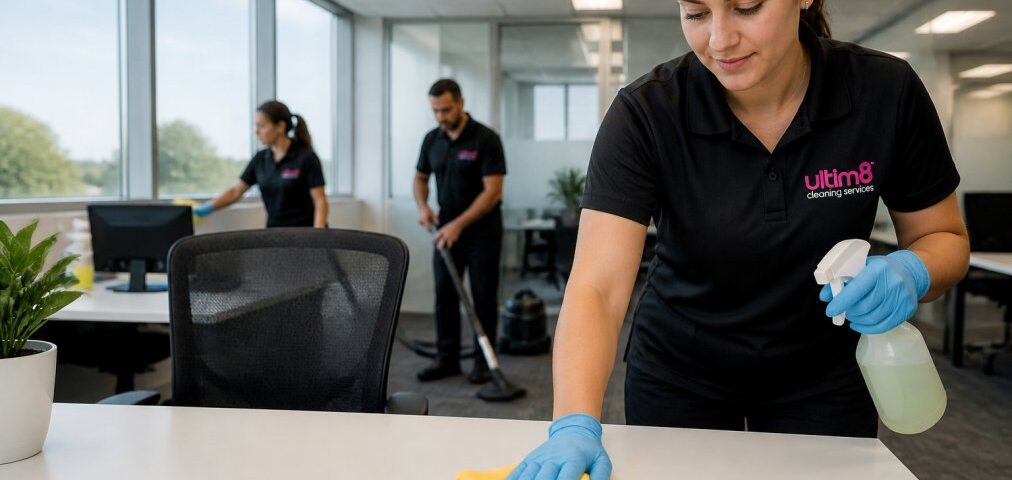
Table of Contents
- Why a Clean Office Matters for Your Team
- Your Daily Office Cleaning Checklist
- Weekly and Monthly Deep Cleaning Tasks
- High-Touch Surface Disinfection Protocols
- Managing Clutter, Waste, and Air Quality
- The Benefits of Professional Office Cleaning
- Common Mistakes to Avoid
- Build a Routine That Sticks
- Frequently Asked Questions
Last Updated: September 8, 2026
Why a Clean Office Matters for Your Team
A clean office is the foundation of workplace productivity, employee health, and professional credibility. Cluttered desks and sticky floors signal neglect, impacting how clients perceive your business and how your team feels about showing up each day.
A tidy environment reduces distractions, while grime on shared surfaces can spread seasonal illnesses through an entire floor within days. This guide from Ultim8 Cleaning Services covers the daily, weekly, and monthly rhythms that keep a workspace truly clean.
Most offices fail because they treat cleaning as an occasional event rather than a system. Below, we show you how to build a routine that protects your team and your reputation, from simple daily habits to knowing when professional help is the smarter investment.
Your Daily Office Cleaning Checklist
The daily routine sets the baseline for everything else. A clean office starts with small, consistent actions that prevent the buildup that leads to deep cleaning emergencies.
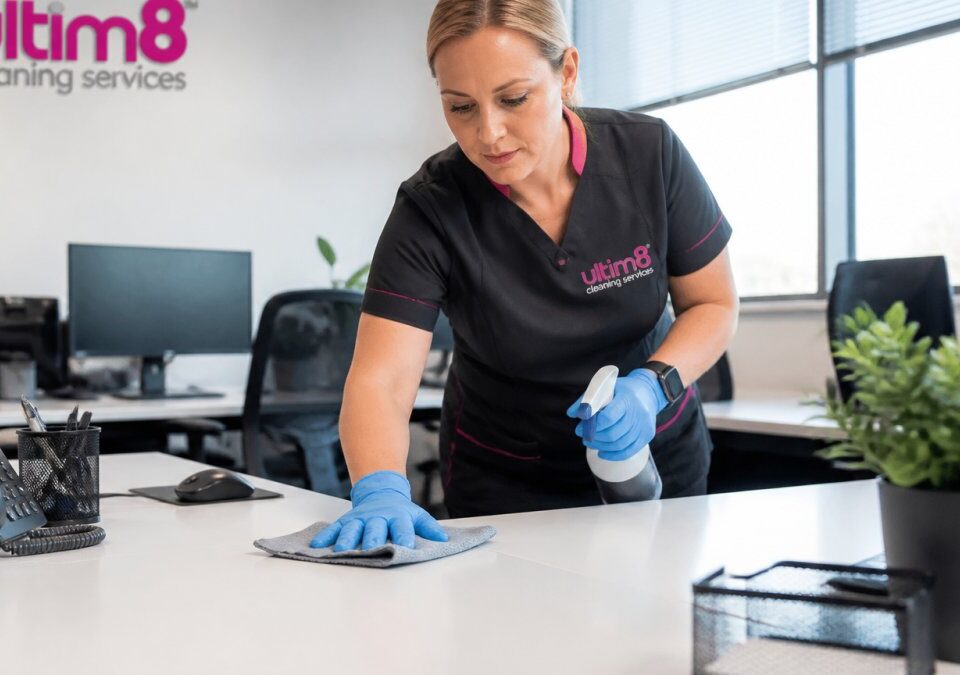
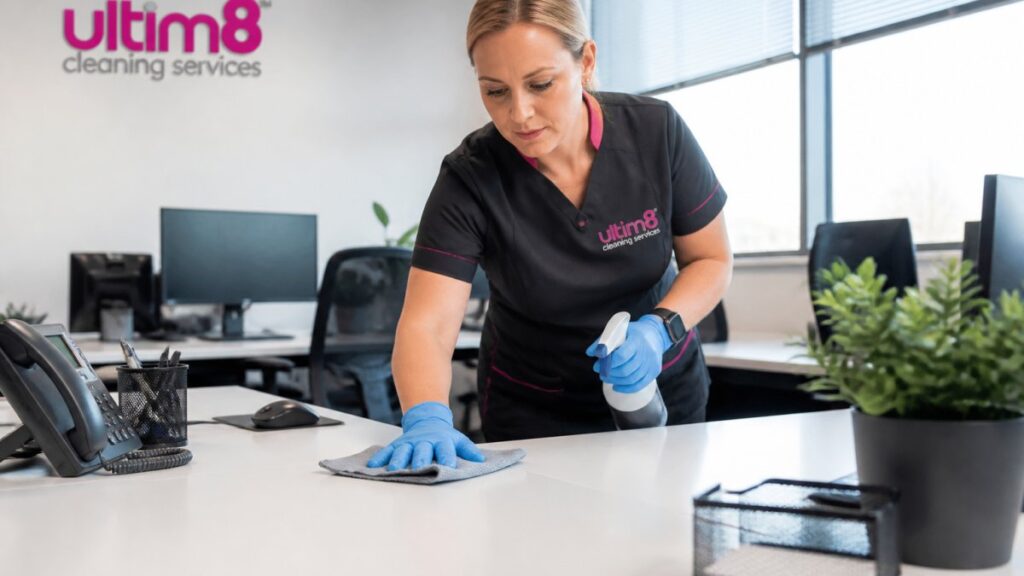
Start each morning by walking the space with fresh eyes. Wipe down desks and shared workstations, empty trash bins that are half full or more, and spot-check the kitchen for stray dishes or spills. These tasks should take one person no more than 30 minutes in a standard office.
A practical daily checklist includes:
- Empty trash and recycling bins before odors develop
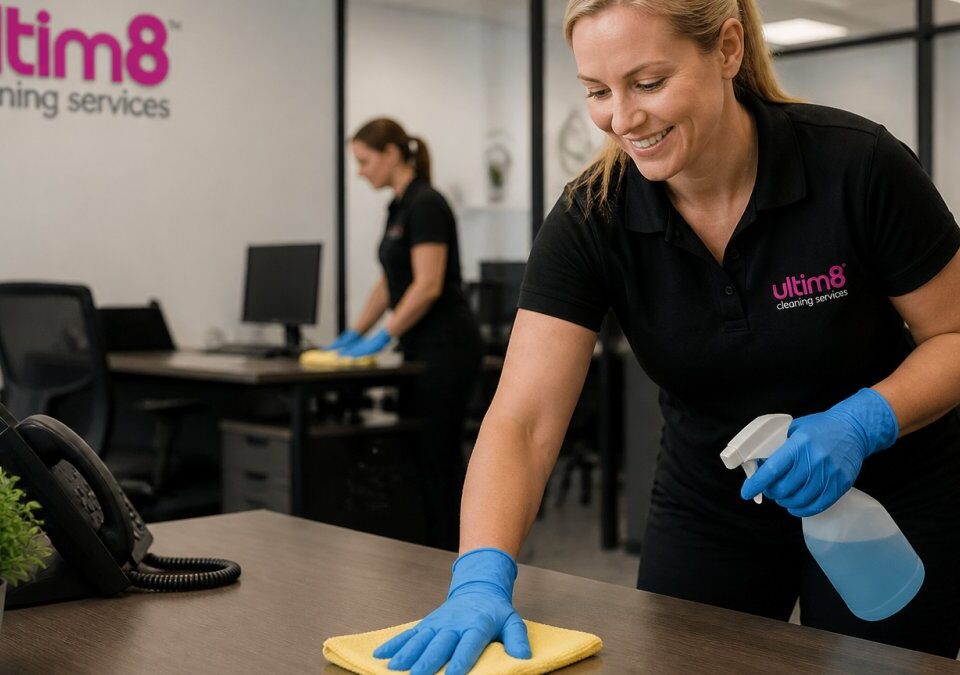
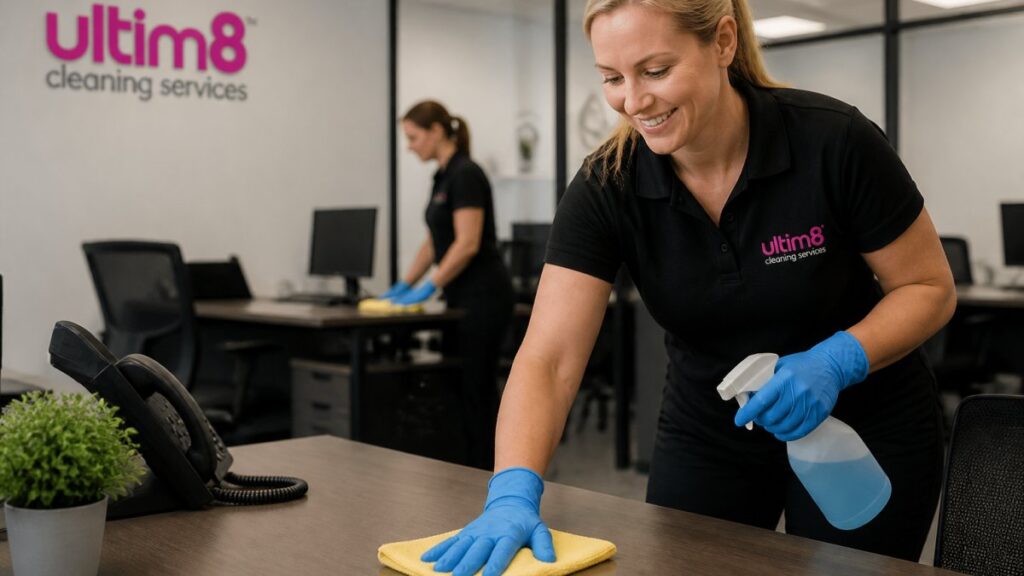
- Wipe desks, keyboards, and phones with a gentle surface cleaner
- Sanitize door handles, light switches, and elevator buttons
- Sweep or vacuum high-traffic entryways and hallways
- Restock paper towels, soap, and hand sanitizer at hygiene stations
- Load and run the dishwasher or wash communal coffee mugs
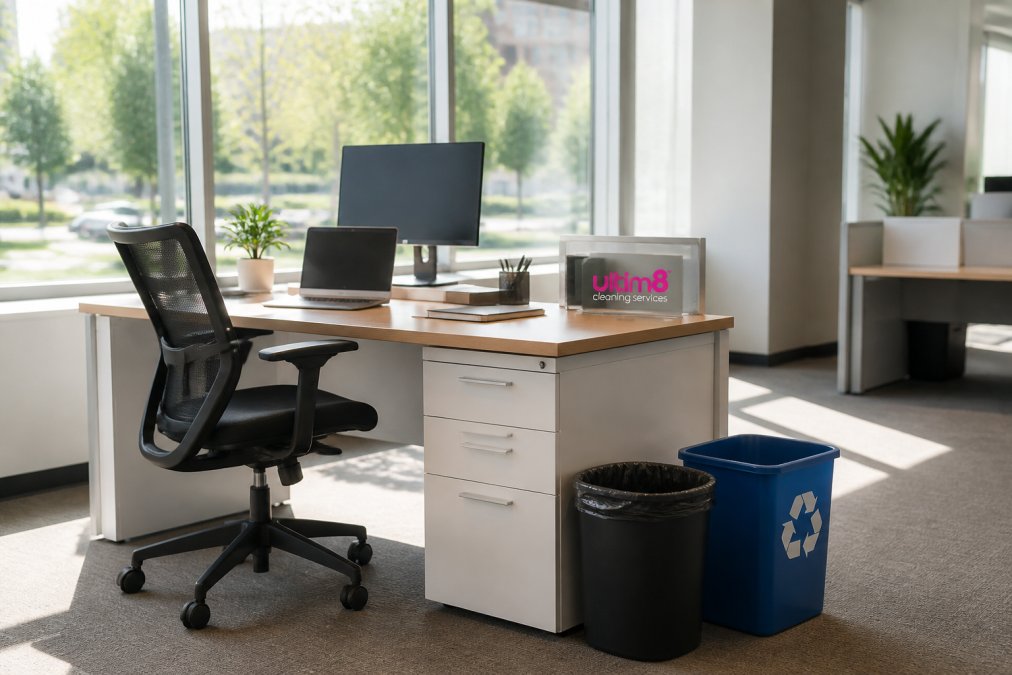
Assign one “closing duties” rotation per week. Having the last person out spend 10 minutes wiping surfaces and emptying bins prevents the morning rush from feeling like a fire drill.
Weekly and Monthly Deep Cleaning Tasks
Daily tasks manage the surface layer, but grime accumulates where daily checklists don’t reach. Weekly and monthly deep cleaning prevents the slow buildup that makes an office look tired and smell stale.
Weekly, vacuum under desks and along baseboards, mop hard floors with a proper floor cleaner, disinfect breakroom appliances inside and out, wipe down conference room tables and whiteboards, and clean interior glass partitions.
Monthly, rotate through heavy-duty tasks: dust vents and ceiling fans, shampoo high-traffic carpet areas, wipe cabinet fronts and baseboards, and clear out the refrigerator. A monthly deep clean is the difference between maintenance and preventative care for your office furniture and flooring.
| Task Type | Frequency | Time Estimate | Primary Focus |
|---|---|---|---|
| Surface wiping | Daily | 15-30 min | Germ reduction on shared surfaces |
| Vacuuming & trash | Daily | 20-30 min | Floor care and odor control |
| Breakroom deep clean | Weekly | 45-60 min | Appliance and sink sanitation |
| Vent dusting | Monthly | 1-2 hours | Air quality and allergen control |
| Carpet shampoo | Quarterly | 2-4 hours | Stain removal and fabric longevity |
High-Touch Surface Disinfection Protocols
High-touch surface disinfection is the most important part of office cleaning for employee health. Door handles, light switches, elevator buttons, and shared printers are touched by dozens of hands daily, making them primary vectors for cross-contamination.
The right protocol is frequency, not just thoroughness. Disinfect high-touch points at least once mid-day, and again after lunch in a busy office. Use an EPA-registered disinfectant and let it sit for the contact time listed on the label; wiping it off immediately defeats the purpose.
The most common mistake is using one cloth for the whole office. A rag wiped across a dirty keyboard then across a door handle simply moves bacteria. Use disposable wipes or color-coded microfiber cloths designated for specific zones to prevent cross-contamination.
Place sanitizing wipes next to printers, copiers, and conference room phones so employees can clean surfaces before and after use, reducing the burden on your scheduled routine.
Managing Clutter, Waste, and Air Quality
A clean office is impossible if clutter accumulates. Paper piles, loose cables, and overflowing shelves collect dust and make surface cleaning ineffective. A “clean desk” policy at the end of each day is the simplest way to keep clutter under control. But the modern office is rarely full five days a week, and that changes the maintenance calculus entirely.
Cleaning Schedules for Hybrid and Low-Traffic Offices
Most cleaning guides assume a fully occupied office, but the post-pandemic workplace is often at 40% to 60% occupancy. This creates two problems: under-cleaning on high-occupancy days and over-cleaning on empty days. The fix is a demand-based schedule rather than a fixed calendar.
Map your occupancy data. If your office peaks on Tuesdays and Wednesdays, schedule the deep-cleaning pass for Thursday morning. On low-traffic days, reduce the daily checklist to trash removal, restroom checks, and a quick walk-through for spills. This saves labor hours and reduces wear on flooring and equipment.
For desks that sit empty for days, adopt a “touchless reset” protocol. Focus daily wiping on shared zones, kitchens, conference rooms, and restrooms, and give personal desks a full wipe-down only when an employee returns after an extended absence. This cuts daily cleaning time by up to 30% without compromising hygiene.
Waste Management That Matches Real Volume
Position recycling bins next to every trash can to make the right choice the easy choice. In a hybrid office, right-size your pickup schedule, a service that empties bins daily when the office is half-empty is wasted spend. Review waste volume monthly and adjust pickup frequency to match occupancy trends.
Electronic waste is a separate stream offices often mishandle. Under the Resource Conservation and Recovery Act, certain discarded electronics may be subject to federal hazardous waste regulations, and many states have their own e-waste mandates. Partner with a certified electronics recycler (look for R2 or e-Stewards certification) rather than tossing old monitors in the dumpster. Most recyclers offer free pickup for business volumes, and some provide a certificate of data destruction for compliance.
Air Quality as a Maintenance Metric
Air quality is the invisible component of a clean office. Change HVAC filters on the manufacturer’s schedule, typically every 90 days for standard MERV-8 filters, but more frequently in dusty environments or during high pollen seasons. Ensure ventilation systems are unobstructed by furniture or stored boxes. Guidance from the Environmental Protection Agency notes that indoor air quality directly affects occupant health and comfort, making ventilation maintenance a core part of any office cleaning plan.
For hybrid offices, a $50 to $100 indoor air quality monitor tracking particulate matter (PM2.5) and carbon dioxide can tell you when a space needs attention. If CO2 levels spike above 1,000 ppm during a meeting-heavy day, your ventilation is underperforming regardless of how clean surfaces look. This turns air quality into a measurable maintenance metric.
The Benefits of Professional Office Cleaning
Daily and weekly routines handle the basics, but there is a ceiling to what an in-house team can achieve. Hiring a professional service is an operational and financial trade-off that most guides ignore. Here is a practical framework for making that call.
The In-House Cost Reality
Most office managers underestimate the true cost of internal cleaning labor. Paying a staff member $18 per hour for 10 hours a week of cleaning is $180 in direct wages, but closer to $230 per week once you factor in payroll taxes, workers’ compensation insurance, and paid time off. Over a year, that exceeds $11,000 for tasks that pull your team away from revenue-generating work.
That figure does not include supplies. A standard office consumes roughly $0.50 to $1.00 per square foot annually in cleaning chemicals, paper products, and trash bags, an additional $2,500 to $5,000 per year for a 5,000-square-foot office. Add equipment (a commercial-grade vacuum costs $300 to $600, and a carpet extractor rental runs $80 to $150 per day), and the in-house model quickly becomes a significant line item.
What Professional Services Actually Cost
Professional office cleaning is typically priced per visit or per square foot. For standard weekly service, commercial cleaners in most U.S. markets charge between $0.08 and $0.15 per square foot per visit. A 5,000-square-foot office therefore runs $400 to $750 per week, or roughly $1,600 to $3,000 per month, including labor, supplies, equipment, and liability insurance.
The comparison is not always in favor of outsourcing. For offices under 2,000 square feet with minimal traffic, a dedicated part-time cleaner or well-managed internal rotation can be more cost-effective. The break-even point for most businesses lands between 2,500 and 5,000 square feet, where a professional crew’s efficiency outpaces internal labor plus equipment amortization.
Service Models to Consider
Professional services are not one-size-fits-all. The three most common engagement models are:
- Recurring janitorial (daily or weekly): Best for high-traffic offices that need consistent surface cleaning, trash removal, and restroom maintenance. Contracts typically run 12 months with a 30-day termination clause.
- Periodic deep cleaning (quarterly or semi-annual): Targets carpet shampooing, vent dusting, and window cleaning. This is a cost-effective middle ground for offices that handle daily tasks internally but lack heavy equipment.
- Hybrid split: A professional crew handles daily trash and restrooms, while internal staff manages desk wiping and breakroom tidiness. This model reduces cost while keeping a human presence for security-sensitive areas.
Vetting Criteria That Matter
When evaluating a provider, verify three things beyond price. First, confirm they are insured and bonded, ask for a certificate of insurance. Second, check whether staff are employees or subcontractors; employee-based firms typically have more consistent training and background checks. Third, ask for a detailed scope of work listing every task, frequency, and the specific EPA-registered disinfectants they use.
Request a trial month before signing a long-term contract. A reputable service will agree to a 30-day pilot so you can verify consistency, communication, and quality before committing to a 12-month agreement.
For offices over 2,500 square feet, significant foot traffic, or businesses that want verifiable results without pulling employees from core work, professional cleaning is typically the smarter investment. For smaller spaces, a disciplined internal routine with a quarterly professional deep clean often delivers the best balance of cost and quality.
Common Mistakes to Avoid
Many offices sabotage their own cleaning efforts with well-intentioned but ineffective habits.
Using the wrong products. Glass cleaner on granite, all-purpose spray on wood, and bleach-based products on colored fabrics cause damage that no amount of wiping can fix. Match the product to the surface, and train staff on which cleaners go where.
Cleaning without a schedule. When cleaning is “whenever someone notices it’s dirty,” it rarely happens. Without a written schedule, tasks fall through the cracks and the office declines until a crisis forces action.
Neglecting the breakroom. The kitchen is the highest-risk area for germs and the most common source of office odors. Leftover food in the fridge and crumbs in the microwave attract pests and create a workplace safety issue. Food safety guidance for commercial facilities emphasizes that regular cleaning of food preparation areas is essential for preventing contamination.
Forgetting the “invisible” surfaces. Light fixtures, air vents, and under-desk areas accumulate dust that triggers allergies and makes the whole office feel stuffy. These areas need scheduled attention, not just occasional notice.
Build a Routine That Sticks
The best cleaning plan fails if it isn’t executed consistently. Building a routine that sticks requires assigning ownership, setting reminders, and tracking completion.
Write the schedule down and post it where everyone can see it. Assign specific tasks to specific people or teams on a rotating basis so no one feels unfairly burdened. Use a shared digital calendar with reminders for weekly and monthly tasks.
For many offices, the most reliable solution is partnering with a professional service. Ultim8 Cleaning Services provides insured and background-checked cleaners who work through detailed checklists, ensuring every high-touch surface and hidden corner gets attention. Our team uses high-quality, environmentally safe products, so you get a spotless office without harsh chemicals lingering in your workspace.
Maintaining a clean office is a system, not a single event. Daily checklists, weekly deep cleaning, and proper disinfection protocols create the baseline, while professional support fills the gaps that internal routines miss. With Ultim8 Cleaning Services, you get dependable scheduling and expert attention to detail, giving you back the time to focus on your business. Workplace health and safety resources from OSHA can help you identify additional standards relevant to your facility. Get started with Ultim8 Cleaning Services and book your office cleaning today.
Frequently Asked Questions
How often should high-touch surfaces be disinfected in an office?
High-touch surfaces like doorknobs, light switches, elevator buttons, and shared keyboards should be disinfected at least once a day. In offices with high traffic or shared workstations, schedule disinfection twice a day, such as mid-morning and late afternoon. During cold and flu season, consider increasing frequency. A simple routine using EPA-approved disinfecting wipes or sprays on these surfaces reduces the spread of germs and keeps your team healthier.
What is the best way to create an effective office cleaning schedule?
Start with a daily checklist that covers emptying trash, wiping down kitchen counters, and disinfecting high-touch points. Then assign weekly tasks like vacuuming, mopping, and sanitizing restrooms. Monthly, focus on deep cleaning tasks such as washing windows, shampooing carpets, and dusting vents. Divide responsibilities among staff or coordinate with a professional service. Post the schedule in a shared space so everyone knows what to expect and who handles each task.
What are the signs that my office needs professional cleaning help?
If you notice lingering odors, visible dust buildup on desks and vents, or sticky floors that daily vacuuming doesn’t fix, it’s time to call in professionals. Other signs include grout discoloration in restrooms, streaky windows, and a general decline in workplace morale. Professional cleaners bring equipment and expertise for deep tasks like carpet extraction and tile scrubbing. Their work also supports a healthier environment by reducing allergens and germs that routine cleaning misses.
How does a clean office environment impact employee productivity?
A tidy office reduces distractions and helps employees focus on their work instead of clutter. Studies show that organized workspaces lower stress and improve concentration. Clean air and surfaces also mean fewer sick days, keeping your team present and engaged. When employees see that their workspace is cared for, morale improves. Maintaining a clean office is a simple way to support both physical health and daily productivity.