How to Maintain Office Hygiene Standards Daily
October 3, 2026
Table of Contents
- Setting Expectations for Your First Professional House Cleaning
- How to Prepare for a House Cleaner Before They Arrive
- Your House Cleaning Checklist for the First Visit
- Basic Clean vs. Deep Clean: What Changes and What Doesn’t
- Vetting, Safety Protocols, and Access Instructions
- House Cleaning Tipping Etiquette and Communication With Your Cleaner
- What the Average Cost of House Cleaning Services Covers
- Frequently Asked Questions
Last Updated: October 3, 2026
Setting Expectations for Your First Professional House Cleaning
Walking into a spotless home after a professional house cleaning service is one of the most satisfying feelings a busy homeowner can experience.
Professional house cleaning is a structured service in which trained, insured cleaners follow a defined checklist to clean your home’s surfaces, fixtures, and floors using professional-grade products.
Here is what the first visit looks like, how to prepare, and how to make the arrangement work smoothly.
What a Standard Visit Includes
A standard maintenance clean covers the core tasks most households need on a recurring basis. According to ISSA cleaning industry standards, professional cleaning follows established protocols for surface care and sanitization.
Typical standard-visit tasks include:
- Surface dusting of furniture, shelves, and decor
- Vacuuming carpets, rugs, and upholstery
- Mopping hard floors
What is not included in a standard visit: inside-oven cleaning, inside-fridge cleaning, wall washing, and garage sweeping. Those fall under deep cleaning.
How Long a Professional House Cleaning Typically Takes
A standard clean for a two-bedroom home generally takes two to three hours with a two-person team. Larger homes, heavier buildup, or add-ons extend that window, and a first-time deep clean often takes twice as long because the team is addressing accumulated grime.
Book your first clean when you have a three-to-four-hour window available. Even if the team finishes early, you will not feel rushed, and you can do a walk-through before they leave.
How to Prepare for a House Cleaner Before They Arrive
The best preparation is simple: clear surfaces, secure valuables, and contain pets. Prepped homes get a more thorough clean because cleaners spend their time cleaning rather than moving clutter.

Decluttering, Securing Fragile Items, and Pet Safety
Decluttering is the highest-impact step. Pick up clothing, toys, papers, and dishes so counters, floors, and furniture are accessible.
Move heirlooms, ceramics, and electronics to a closed cabinet or a “do not touch” area, and tell the team what is off-limits.
Pet safety matters for everyone. Even the friendliest dog can become anxious when a stranger enters with equipment, so confine pets to a crate or closed room.
A useful preparation checklist for the first visit:
- Clear countertops and floors of personal items
- Secure jewelry, cash, and fragile decor
- Confine pets or schedule them elsewhere
Your House Cleaning Checklist for the First Visit
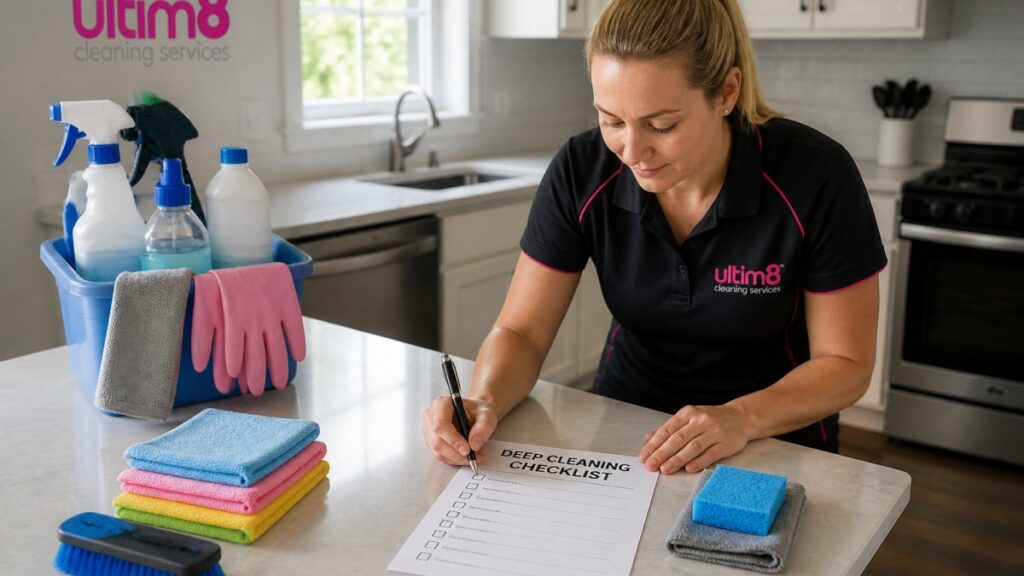
A first-visit checklist is the contract between your expectations and the cleaner’s scope. Walk through the home together at the start, or leave a written list on the counter.
Your first-visit checklist should confirm:
- Which rooms are included
- Which tasks are standard versus add-on
- Where supplies are stored
- Any surfaces that need special products (stone, wood, stainless)
- How you want the home left (lights off, doors locked)
The cleaner’s own checklist should mirror yours. Ultim8 Cleaning Services trains every team member to work through a detailed checklist so nothing gets missed.
Post-Cleaning Inspection Checklist and Quality Assurance
After the first clean, walk through before the team leaves. Check high-traffic areas, baseboards, shower tracks, and soap scum on glass, and note anything needing a touch-up on the spot; most reputable services address it immediately.
A quick inspection checklist:
- Bathroom grout and shower track free of soap scum
- Kitchen appliance exteriors wiped
- Floors free of streaks and debris
If something is missed, say so right away. A service agreement or satisfaction policy usually covers a return visit.
Basic Clean vs. Deep Clean: What Changes and What Doesn’t
The difference between a basic clean and a deep clean comes down to scope, not skill. A basic clean maintains a home already in good shape; a deep clean resets one with accumulated buildup.
| Feature | Basic Clean | Deep Clean |
|---|---|---|
| Surface dusting | Yes | Yes |
| Floors (vacuum/mop) | Yes | Yes |
| Inside oven | No | Yes |
| Inside fridge | No | Yes |
| Baseboards and door frames | Spot only | Full |
| Shower track and soap scum | Light | Detailed |
| Duration (2BR home) | 2-3 hours | 4-6 hours |
| Best for | Recurring maintenance | First visit, move-in/out, spring cleaning |
Most new clients start with a deep clean, then move to recurring standard maintenance. That sequence delivers the best long-term results.
Vetting, Safety Protocols, and Access Instructions
Trust is the foundation of a good cleaning relationship, and it is the part most new clients under-research. Before any cleaner enters your home, answer three questions with documentation, not verbal assurance: Is this person background-checked? Is the company insured? What happens if something breaks?
How to Verify a Cleaning Company’s Credentials
Most reputable residential cleaning companies answer these questions without hesitation. If a company dodges them, treat that as a signal.
- Background checks. Ask whether the company runs criminal background checks on every cleaner, not just the owner or the lead, and whether checks are re-run periodically. A common pattern is a national criminal search plus a sex-offender registry check at hire. Some companies also run motor-vehicle checks for cleaners who drive to jobs.
- Liability insurance. Ask for a Certificate of Insurance (COI). This is a one-page document from the insurer listing the policyholder, coverage limits, and effective dates. You can request a COI naming you as an additional insured for the visit, though most residential clients simply review the certificate. General liability typically covers accidental damage to your property; it does not cover theft, which is usually handled separately.
- Bonding. A surety bond protects you if a cleaner steals from your home. Bonding and insurance are not the same thing, and a company can carry one without the other. Ask specifically about both.
What to Do If Something Is Damaged
Damage happens. The difference between a stressful incident and a non-event is whether the company has a documented claims process.
Ask in advance: Who do I contact if something breaks? Is there a claims form? What is the response window? Reputable companies will replace or repair damaged items up to the policy limit, and they will not ask you to sign a waiver of liability before the first clean.
Access Instructions and Home Security
How a cleaner gets into your home is a security decision, not just a convenience one. The three common options each carry trade-offs:
- You are home. Highest control, but it limits scheduling flexibility and can slow the cleaner down if you are working or on calls.
- Lockbox or keypad. A lockbox with a code you can change is the most common arrangement. Give the code in writing, change it if the arrangement ends, and never leave a key under a mat or flowerpot.
- Smart lock. Best for auditability, most smart locks log every entry and can issue temporary codes that expire after the visit. If your lock supports it, a one-time or time-bound code is the safest option.
Whichever you choose, put instructions in writing and confirm them the day before, including alarm codes, pet notes, and off-limits rooms. A short written brief prevents most first-visit confusion.
Before booking, request the COI, confirm background-check scope, and ask about bonding and workers’ comp. A company that cannot produce these documents is not one you want holding a key to your home.
House Cleaning Tipping Etiquette and Communication With Your Cleaner
Etiquette is where most new clients feel the most uncertainty. There are no rigid rules, but norms make the relationship smoother for both sides.
Tipping: What Is Standard
Tipping is appreciated but not required, and never expected on a first visit. A common approach is 10 to 20 percent per visit for a regular cleaner, or a flat $10 to $20 per cleaner for one-time service.
How to tip:
- Cash left on the counter with a note is the most common method and is never awkward.
- Many companies now allow in-app tips at checkout; if you pay by card, ask whether the tip reaches the cleaner directly.
- If you use a service that pools tips, the individual cleaner may see less than you intend. Ask.
Do not feel obligated to tip on a first visit before you know whether the work meets your standards. Tip on the second visit if you are happy.
Should You Be Home During the Clean?
There is no single right answer; the choice comes down to comfort and logistics.
- Being home gives you the chance to point out problem areas in real time and to do a walk-through before the cleaner leaves. It also means you may need to stay out of the way, which can slow the work in small homes.
- Not being home is the norm for recurring clients. It is faster, more efficient, and most cleaners prefer it because they can work without interruption. The trade-off is that you inspect after the fact rather than during.
A common middle ground: be home for the first visit, then transition to remote access for recurring cleans once you trust the arrangement.
Supplies: Who Provides What
Most professional services bring their own supplies and equipment, including vacuums, mops, and cleaning solutions, part of what your fee covers. Exceptions:
- If you have specialty surfaces (natural stone, sealed wood, certain stainless finishes), you may prefer to provide the product the manufacturer recommends. Leave it out with a note.
- If you have a preferred vacuum for a specific floor type, let the company know in advance.
- If you are sensitive to fragrances or specific chemicals, tell the company before the first visit so they can adjust.
Do not assume the cleaner will use your supplies unless you have discussed it. A quick note on the counter resolves the question.
Giving Feedback Without Awkwardness
Direct, specific, same-day feedback is the best thing you can do for the relationship. Cleaners cannot fix what they do not know about, and small issues compound into cancellations if left unspoken.
A simple framework:
- Be specific. “The shower track in the hall bath still has soap scum” is actionable. “The bathroom looks bad” is not.
- Be timely. Say it the same day, ideally before the cleaner leaves. Waiting until the next visit makes it impossible to verify.
- Be proportionate. A missed baseboard is a touch-up request, not a reason to cancel. A pattern of missed items across multiple visits is a conversation with the company, not the individual cleaner.
Do not leave complaints until the next scheduled visit. By then, the cleaner cannot verify the issue, and small problems compound into cancellations.
Communication Between Visits
Most companies have a preferred channel, text, email, or an app, for schedule changes, add-ons, and questions. Use it. A cleaner who learns about a party the night before via a counter note may not have time to adjust; a week’s notice lets the company add time or send a second cleaner.
What the Average Cost of House Cleaning Services Covers
Pricing for professional house cleaning depends on home size, frequency, and scope. Companies typically quote by the hour, by the square foot, or as a flat fee per visit. Recurring visits cost less per clean than one-off service because the home stays in better condition between appointments.
What your fee covers:
- Labor for the scheduled duration
- Use of professional cleaning supplies and equipment
- Liability coverage and insurance
For a personalized quote based on your home and schedule, visit the Ultim8 Cleaning Services website. We provide transparent pricing before the first visit.
Frequently Asked Questions
What should I expect during a first-time professional cleaning visit?
Your first visit usually starts with a walk-through so the team can confirm priorities and any access instructions. Expect surface dusting, vacuuming, mopping, kitchen and bathroom sanitizing, and high-traffic areas to be covered. Because it is the first visit, many services allow extra time to address buildup. If your home has not had a professional house cleaning recently, ask whether a deep clean is recommended before starting recurring visits.
How do I prepare my home for a professional cleaning service?
Clear floors and counters of personal items, put away fragile items, and secure pets in a quiet room. Leave access instructions and any special notes, such as which products to avoid. If you work from home, let the team know which rooms to skip until later. A few minutes of decluttering before they arrive lets cleaners focus on surface dusting, vacuuming, and sanitization instead of moving your belongings.
What is the standard tipping etiquette for house cleaning services?
Tipping is optional but appreciated, and 10 to 20 percent of the service total is a common range for a job well done. For recurring visits, some households tip at each visit while others tip once during the holidays. If you use a flat fee or hourly rate, base the tip on the final invoice. Cash is simplest, though many services can add a tip through their payment system.
How much do professional house cleaning services cost?
Pricing depends on your home’s size, condition, and whether you choose a one-off service or recurring visits. A standard maintenance clean usually costs less per visit than an initial deep clean because it covers fewer tasks. Some companies charge an hourly rate, while others quote a flat fee. Ultim8 Cleaning Services does not publish rates online, so request a quote for your specific home and schedule.
Hiring a cleaner should give you back your evenings, not create new worries. Whether you need recurring residential service, a one-time deep clean for a move, or detail-oriented office cleaning, Ultim8 Cleaning Services delivers insured, background-checked cleaners, environmentally safe products, instant online booking, and a checklist-driven process that leaves nothing to chance. Get started with Ultim8 Cleaning Services and reclaim your time.